
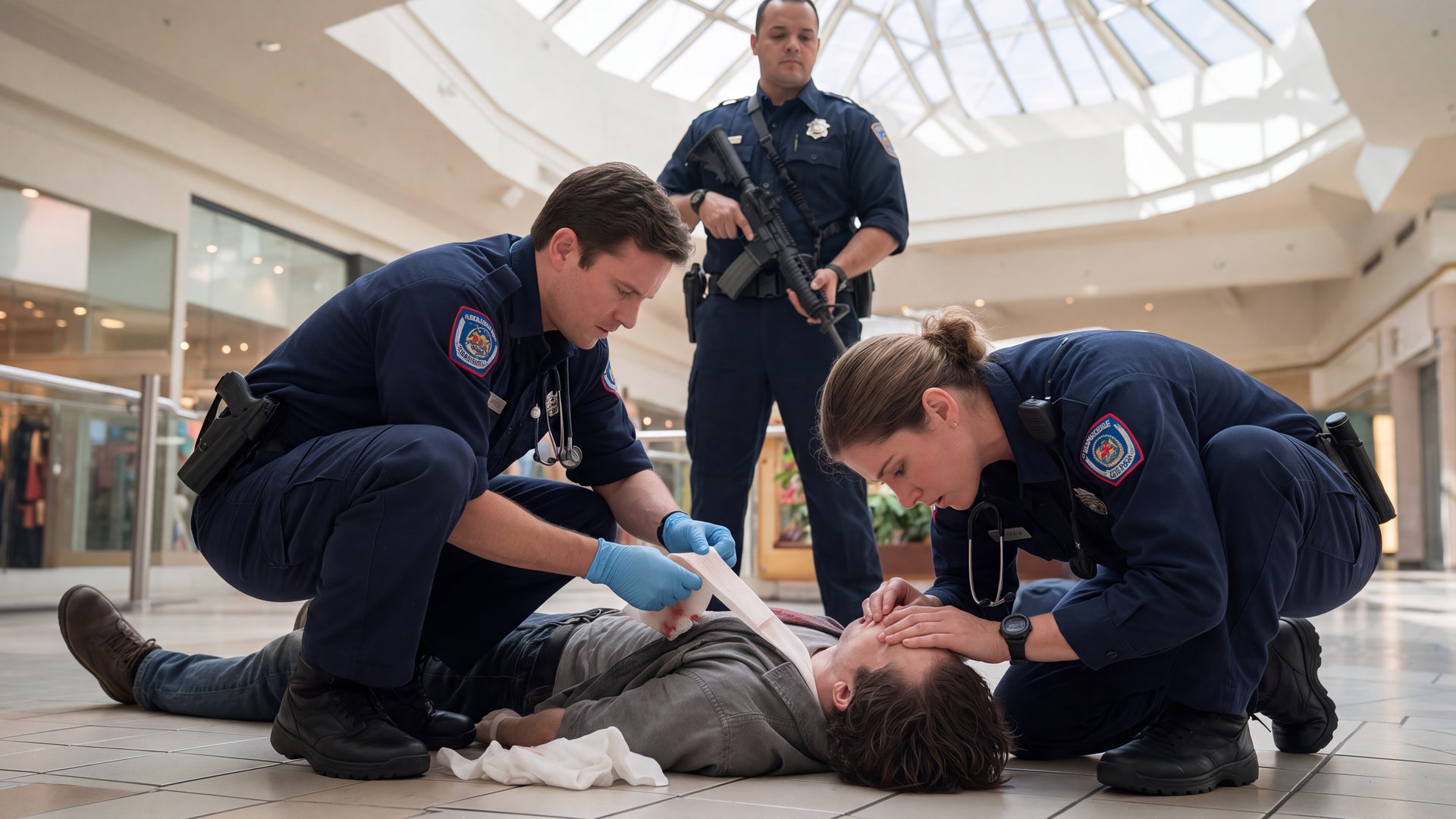
In an active shooter incident, Indirect Threat Care is conducted primarily in the Warm Zone but may carry into the Cold Zone. Assessment and treatment focus on preventable causes of death: major bleeding, airway compromise, and hypothermia. Responders provide emergent stabilizing treatment with an emphasis on rapid transportation of injured from the scene to definitive care prioritized by injury severity.
Most active shooter incidents are NOT mass casualty incidents (MCI). Establishing a treatment area in the Cold Zone (because of the assumption it will be a mass casualty incident when it is not) delays transport to definitive care, especially surgical care. The default action is for Rescue Task Forces to move injured directly from the Warm Zone to an ambulance waiting at the Ambulance Exchange Point.
Indirect Threat / Warm Zone Treatment
| Intervention | First Responder (2024) | BLS/ALS (2025) |
|---|---|---|
| Tourniquets, packing, pressure dressings, junctional TQ | Yes | Yes |
| TQ reassessment | Tighten or add a second TQ only | Same, plus assess necessity, remove if not needed, keep if evac under 2 hrs |
| TQ downgrade/conversion | Not addressed | Yes, if evac delay over 2 hrs and patient responding to resuscitation; don’t retry a failed attempt |
| Airway | Clear mouth, chin lift/jaw thrust, NPA, recovery position | Adds supraglottic airway, oro/nasotracheal intubation, surgical cric, O2 |
| Chest wounds | Vented seal (leave open if none); burp for tension | BLS: burp. ALS: needle decompression, 14g/3.25", 2nd ICS MCL or 4th/5th ICS AAL |
| Shock | Recognize and prioritize evacuation | IV/IO (18g min), permissive hypotension (SBP >80), one repeat bolus at 30 min, shock index |
| TXA | Not included | 2 g as soon as possible, not after 3 hrs |
| Calcium | Not included | 1 g CaCl or 3 g Ca gluconate, even when only crystalloid is used |
| Blood products | Not included | 1:1 plasma:PRBC or whole blood via warmer, if protocol allows |
| TBI | Not addressed in this phase | Avoid hypotension (SBP >110), SpO2 >90%, etCO2 35–45, head up 30°, PEEP 5–12 |
| Burns | Stop burning, loose dry dressings, prioritize airway burns | Adds TBSA estimate, fluids if >20%, high-flow O2 for CO, cyanide antidote, early definitive airway |
| Splinting / pelvic binder | Not in the document at all | Yes |
| Spinal motion restriction | Not in the document at all | Identify at-risk patients and apply devices |
| Analgesia | Limit movement; oral acetaminophen if evac is prolonged; celecoxib OK | Adds IV acetaminophen, opioids (with naloxone on hand), ketamine 0.3–0.4 mg/kg IN/IM or 0.1–0.2 mg/kg IV/IO, low-dose benzos for dysphoria, antiemetics |
| Monitoring | “Monitor casualty” | Instrumented monitoring and vital signs |
| Traumatic arrest | No CPR for blast/penetrating arrest | Same, but consider bilateral needle decompression before stopping care |
| Oral fluids | If not in shock and evac is delayed | If not altered and evac is delayed |
Sources: C-TECC First Responders with a Duty to Act (2024) and C-TECC BLS/ALS Clinicians (2025).