
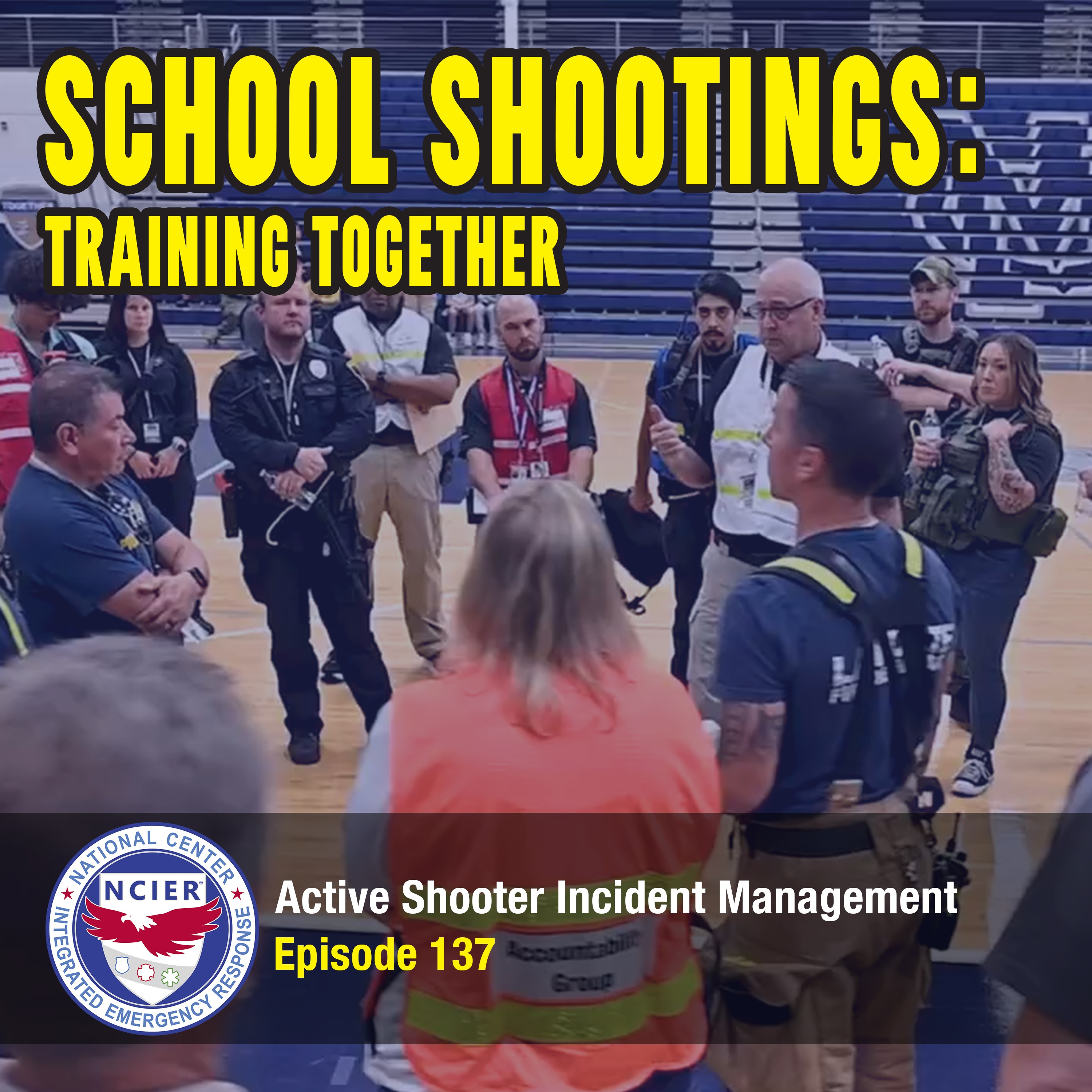
A position paper on regional adoption of Active Shooter Incident Management
We've now run more than 2,700 active shooter incident management exercises across the country. After that many reps, with that many agencies, in that many counties and regions, a pattern is impossible to miss. The departments that train hard, write good SOPs and walk away from class fired up to make a change — most of them never get that change to stick. The program works. What stops working is the implementation, every time it gets driven by a single agency trying to do it alone.
This paper makes one case. If you want active shooter incident management adopted across your region in a way that actually lasts, the work has to be led by emergency management. Not the police chief acting alone. Not the fire chief running point. The Emergency Manager.
Why one chief can't fix this
We see it constantly. A captain or a chief comes through ASIM training, gets excited about what they saw, and goes home determined to roll it out across their county. Six months later they're stuck. The fire department won't get on board. The neighboring sheriff's office is doing it their own way. Dispatch hasn't been brought in. And the conversation has hardened into "this is how we've always done it" before any real training ever happens.
Nothing wrong with the chief in that scenario. Most of them are doing exactly what good leaders do, which is see a problem, take ownership, push for a fix. The trouble is the fix can't live inside one agency. ASIM is a shared playbook by design. The whole premise of the checklist is that on the day of an active shooter incident, law enforcement, fire, EMS and dispatch are all running the same plan together. If two of those agencies are on one playbook and the other two are on something different, what you get is delay, confusion and in the worst case a blue-on-blue. The plan only protects responders and the public if everybody at the scene is operating from it.
That's why a single agency, even a large one, can't drive regional adoption from inside its own walls. The minute the police chief from one city walks up to the fire chief in the next jurisdiction and says "we're going to do this thing, here's how I need you to support it," the politics start. The egos kick in. Old grievances resurface. We call it PPE — personalities, politics and egos. PPE will kill a sound program faster than budget cuts ever will.
Who is already in the right seat
The Emergency Manager is. Look at what they already do every day.
An Emergency Manager coordinates across disciplines. Fire, law enforcement, EMS, public works, public health — they sit at the same table for floods and tornadoes and hurricanes and hazmat. The relationships are built. The phone calls get answered. We used to call it the Rolodex, and not enough people know what a Rolodex is anymore, but the idea holds. A good Emergency Manager has the contacts, the back-channel trust and the hundred-million-dollar handshake already in place with every agency that matters. When they pick up the phone to call the sheriff or the fire chief in the next county over and ask for a meeting, the meeting happens. That alone is worth more than any binder of training material.
Emergency Managers also sit slightly outside the chain of command, which matters more than people realize. Police and fire are rank-structured. A line officer or a company officer who wants to push an idea up four or five levels of supervision is going to have a rough time. But that same line-level responder can call the Emergency Manager directly without violating any norms. The Emergency Manager expects those calls. That's the door that's actually open.
And Emergency Managers usually have the ear of the elected and appointed officials. The county administrator. The city manager. The board of commissioners. When a regional ASIM plan needs to be formally adopted, when grant funding has to be lined up, when policy has to be backed by the people who hold the purse strings, the Emergency Manager is already in those rooms. The police chief and the fire chief have to go ask for that audience. The Emergency Manager is already there.
What goes wrong without an Emergency Manager at the head
Without the Emergency Manager driving it, you get a few predictable failures. Agencies train in silos. They never run the play together until it's real. The training itself starts looking different from one shop to the next because nobody owned the standard. Six different versions of the plan show up to the same incident, which is no plan at all. And the responders themselves — the cops, the firefighters, the medics — pay the cost of that gap on the worst day of their career.
A line we keep coming back to: in a crisis you don't rise to the level of your expectations, you fall to the level of your training. Every chief we've worked with believes their people are ready. Most of them have done good work to get there inside their own department. The honest question is whether they can say their people are ready alongside everybody else who's going to show up. If the answer is "I think so," that answer isn't good enough. It needs to be "I know so." And it only gets to "I know" through shared training, shared exercises and a shared plan that every agency has put their name on.
What success actually looks like
Two examples, because the picture matters.
The first was a single county. A city police department and a city fire department, maybe a dozen people total across the two agencies, came through training and got passionate about ASIM. They knew they had 20-plus other municipalities and county agencies to bring along, and they knew they couldn't pull it off themselves. So they walked it to their Emergency Manager. The Emergency Manager called the first meeting. It took a couple of months to get past the initial debates. Every agency had a different policy. Some had a 30-page binder on active shooter response. Some had nothing written at all. Once they got past the acknowledgement phase, the Emergency Manager lined up grant funding, scheduled training, brought in ASIM Basic train-the-trainer, and inside 12 months they had a countywide adopted plan and roughly 99% of police, fire and EMS responders trained on it. Twelve months. That doesn't happen without an Emergency Manager driving it. It can't.
The second example is at the state level. One state adopted ASIM statewide. They did it through the state emergency management program, with grant funding built in for the training to actually get delivered. That kind of scale doesn't happen through a police chiefs' association alone, or a fire chiefs' association alone. It happens because the emergency management structure is the one place where every discipline already reports in for coordination. The Emergency Manager lane is the only lane wide enough to handle it.
The conversation to have, if you're a responder
If you're a responder reading this — a cop, a firefighter, a medic, a training officer — and you've been through ASIM training, here's what to do. Walk it to your Emergency Manager. Don't drop a 60-page binder on them. Don't show up with a slide deck. Have a conversation.
Tell them this is a community problem, not a department problem. Tell them that whether or not your community has had an active shooter incident, you're at the same level of risk as every community that has. Tell them that your agency may have a good plan, but a good agency plan isn't a shared regional plan, and shared regional plans are their domain. Ask them to call the first meeting. Ask them to bring everybody to the table. Law enforcement, fire, EMS, dispatch and the executives, not just the deputies. Ask them to help you find the grant funding to pay for training, because they know where that money lives.
And tell them what you saw work in class. The ASIM checklist is not a 30-page document. It's a shared playbook simple enough that a captain or a training officer can read it once and get it. That's the whole point. The plan only works if everybody can run it on game day, which means it can't be a binder. It has to be a checklist.
The ask, if you're an Emergency Manager
If you're an Emergency Manager reading this, the ask is straightforward. This is the sweet spot of what your job exists to do. You already coordinate across agencies and jurisdictions for flood, fire, tornado and hazmat. Active shooter response is the same coordination problem with higher stakes and a shorter timeline. Your responders need a shared plan, and you are the only person in the structure who can pull that plan together, get it adopted, secure the funding and keep it maintained over the long haul.
Call the meeting. Get the chiefs in the room together. The actual chiefs, not just their deputies. Get them to acknowledge that even if their agency thinks it's ready, it doesn't know it's ready. Run the play. Then run it again with grant-funded training, tabletops and full-scale exercises. Make ASIM the regional standard for your county.
The communities you serve will never see most of that work, and that is exactly the point. The work is done before game day so the response on game day is the one nobody has to read about in the news.
What this comes down to
The same lesson keeps coming back across 2,700+ exercises. The communities where ASIM sticks are the communities where emergency management led the adoption. The communities where it doesn't stick are the communities where a chief tried to do it solo and the politics and the silos eventually wore the program down.
The funding, the planning and the relationships. That's what emergency management does every day. That's what regional ASIM adoption needs. The match is obvious once you've seen it work a few times, and it's painful to watch when it isn't there.
If you're a responder, walk this position paper to your Emergency Manager and ask them to call the meeting. If you're an Emergency Manager, this is work that's already on your desk. It just hasn't been named active shooter response yet.
Download the one-page version of the conversation guide referenced Talking to Your Emergency Manager About Active Shooter Preparedness, or to discuss what regional ASIM adoption might look like for your community, contact us at .