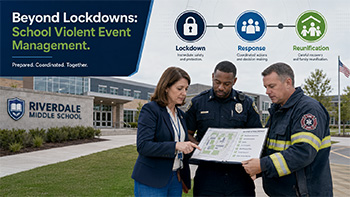
Beyond Lockdowns: A Unified Approach to School Safety and Violent Event Incident Management
Introduction: From Compliance to Readiness
Over the past decade, K‑12 schools across the United States have dramatically increased their focus on safety. Most have implemented lockdown drills, adopted the Standard Response Protocol (SRP), and made physical security improvements. These are important steps. But lockdowns and drills alone do not equal readiness.
When a violent event occurs on a school campus, the response from law enforcement, fire, and EMS is massive, complex, and fast-moving. Multiple agencies converge, often with different radio systems, policies, and internal procedures. If a school’s internal plans are developed in isolation from that operational reality, predictable failure points emerge: misaligned lockdown procedures, confusion about who can initiate critical actions, delays in medical rescue, and chaotic reunification of students with their families.
This white paper outlines a unified, tested framework for school safety and violent event incident management. It is designed for both public safety professionals and school leaders: school administrators, principals, district administrators, classroom teachers, school resource officers, safety and security staff, and school emergency managers.
Drawing on after‑action reports, the Standard Response Protocol and Standard Reunification Method (SRM) from The “I Love U Guys” Foundation, and the School Safety and Violent Event Incident Management (SSAVEIM) framework, we will:
- Examine the strengths and limitations of lockdown as a primary tactic
- Describe what public safety responders will actually do on your campus
- Explain how a shared incident management playbook aligns schools with police, fire, and EMS
- Highlight the often neglected challenge of reunification after a violent event
- Provide a practical roadmap schools can begin implementing this year
The goal is not to replace what schools are already doing, but to connect those efforts into an integrated incident management strategy that public safety partners recognize and support.
1. Lockdown Works – And Why It Is Not Enough
1.1 What the Data Shows About Locked Classrooms
The Sandy Hook Advisory Commission’s final report emphasized the critical importance of locked classroom doors, noting that at the time of publication there were no documented cases in which an active shooter had breached a locked classroom door to kill or injure students inside. [1] Subsequent research and case reviews have identified a small number of exceptions, including incidents in Red Lake, Minnesota (2005), Parkland, Florida (2018), and Apalachee High School in Winder, Georgia (2024). Even in these rare cases, the locked-door failures are notable precisely because they are so unusual.
In contrast, there are multiple documented events in which locked doors likely prevented mass casualties. At Rancho Tehama Elementary School in California in 2017, the attacker crashed a vehicle through the school gates and then spent several minutes attempting to enter classrooms. Surveillance video later showed the assailant trying doors repeatedly and failing to gain entry due to a swift lockdown and locked classroom doors. [2] Similar patterns have been documented at other schools where attackers were unable to enter locked rooms and moved on.
The cumulative lesson is clear: a properly implemented lockdown with locked classroom doors is one of the most effective life‑saving measures schools have. However, it is not a complete readiness strategy. The reality of modern campuses, human stress responses, and the complexity of a violent event introduce gaps that lockdown alone cannot solve.
1.2 Operational Questions Every Campus Must Answer
Lockdown procedures are often written around the ideal case: all students are in classrooms and every door locks easily from the inside. Real campuses are more complex.
Students outside classrooms. During any school day, students are moving between classes, using restrooms, eating in the cafeteria, practicing in the gym, or participating in outdoor activities. A plan that assumes “everyone is in a classroom” leaves teachers and students in hallways, common areas, and outdoor spaces uncertain where to go and who is responsible for securing them. Schools should deliberately plan for:
- Hallways between classes
- Restrooms
- Cafeterias and multiuse spaces
- Gymnasiums and auditoriums
- Playgrounds, fields, and parking lots
- Specialized locations such as swimming pools
Each area may require different procedures and pre‑identified safe locations.
Door hardware and human factors. At Sandy Hook, at least one classroom could not be quickly secured from inside because the locking mechanism required someone to be in the hallway to lock the door. [1] In addition, under extreme stress, fine motor skills deteriorate. If teachers must manipulate small buttons, thumbturns, or recessed locks under pressure, there is a real risk they will fumble or fail. Schools should audit classroom and office doors with this in mind and, where possible, standardize on hardware that can be quickly locked from inside with gross motor movements.
Who can initiate lockdown. Some schools restrict the authority to initiate a lockdown to administrators or supervisory staff. While well‑intentioned, this can introduce fatal delays. If a teacher sees or hears an immediate threat, but must first reach someone else who has the authority and access to activate lockdown, valuable seconds or minutes are lost. A more resilient approach allows any staff member who reasonably believes there is a threat to initiate lockdown, with the understanding that false activations will be handled through training and debriefs, not punishment.
How lockdown is activated. Schools use a variety of methods to start a lockdown:
- Public address (PA) announcements
- Dedicated pull stations or panic buttons
- Radio calls
- App‑based alerting systems
- PBX or classroom phone systems
Each method brings specific vulnerabilities: physical location of PA controls, staff familiarity, coverage gaps for radio or Wi‑Fi, and system redundancy. Schools should map their campus, identify where and how lockdown can be initiated, and ensure there is a simple, clearly understood backup if the primary method fails.
Standard language and training. In an emergency, ambiguity creates confusion. A standard script for announcing lockdown (aligned with SRP terminology) helps ensure staff and students know exactly what is happening and what actions are required. Staff must not only be familiar with the script in theory; they should have practiced using it under time pressure and in realistic training scenarios.
1.3 Managing Classrooms During Lockdown
Once students are secured in locked classrooms, teachers face additional challenges: maintaining silence, managing fear, and handling the inevitable question of cell phones.
Some training materials recommend turning phones off completely to avoid light, sound, or vibration that could attract an attacker. In practice, many students will resist this, and parents often expect direct communication from their children during an incident. A more realistic approach is:
- Instruct students to silence phones fully, including disabling vibration and notification banners.
- Dim screens and avoid unnecessary use.
- Designate one student per room (or the teacher) to send a concise text to 911, where local systems support text‑to‑911. A basic message might include:
- The room number or specific location
- The approximate number of people in the room
- Whether there are any injuries in the room
- Whether the attacker is in or near that location
This simple communication can provide dispatchers and responders with critical real‑time information and reduce uncertainty about which rooms are secure.
Some schools may also establish a dedicated email inbox that teachers or designated students can use to send brief status updates (“Room 205, 24 students, 1 staff, no injuries, lockdown holding”). While these emails are unlikely to inform immediate tactical decisions, they can be valuable during later accountability and reunification efforts, providing a time‑stamped record of conditions across the campus.
1.4 Fire Alarms During Lockdown
Most jurisdictions require immediate evacuation when a fire alarm sounds. At the same time, several school attacks have involved the use of alarms or smoke to drive people into hallways and open areas where they are more vulnerable to an assailant.
This tension cannot be resolved in isolation by the school. It requires deliberate pre‑planning with local fire departments and law enforcement. Together, school and public safety leaders should define how to handle a fire alarm during an ongoing or suspected violent event, how secondary confirmation will be obtained, and how those procedures will be trained and exercised.
2. What Public Safety Will Actually Do on Your Campus
To build a shared playbook, school leaders and staff need a clear picture of what law enforcement, fire, and EMS will actually do when they arrive. While every incident is unique, modern response models for active shooter and active attack events share three overarching operational priorities:
- Active Threat – locate and stop the assailant
- Rescue – provide rapid medical care and evacuate the injured
- Clear – secure the environment and ensure no additional threats remain
2.1 Contact Teams and the Active Threat
The first officers on scene, whether school resource officers, local police, or deputies, will rapidly form small teams whose primary mission is to locate and neutralize the active threat. These Contact Teams move quickly, weapons drawn, often giving loud, urgent commands to anyone they encounter.
From the school’s perspective, this phase can feel chaotic and even unsettling. Staff may see officers moving past wounded individuals, stepping over students or colleagues in distress. This is not neglect; it reflects an understanding that stopping the attacker as quickly as possible is the single fastest way to prevent further casualties and make it safe for medical personnel to enter.
For school staff and students, the most important actions during this phase are:
- Remain in lockdown unless directed otherwise
- Follow officer commands promptly and without argument
- Avoid sudden movements toward officers
Understanding this in advance helps reduce the shock of seeing law enforcement move past injured people or enter spaces aggressively focused on the threat.
2.2 Rescue Task Forces and Medical Evacuation
Once the active threat is contained, attention shifts to rapid medical rescue. Many communities now use a Rescue Task Force (RTF) model: integrated teams of law enforcement officers providing security for fire and EMS personnel who enter the “warm zone” to find, treat, and remove the injured.
RTFs typically:
- Move to Casualty Collection Points (CCPs) identified by initial officers
- Apply life‑saving interventions such as tourniquets
- Organize and prioritize patients for evacuation
- Coordinate with transport units to move patients off scene
For schools, this means injured students or staff may be moved to intermediate locations on campus before being transported to hospitals. These CCPs may be in hallways, near exits, or in other spaces that were not originally envisioned as medical areas. Pre‑incident planning with local fire and EMS can help identify likely CCP locations and routes that minimize disruption to locked‑down classrooms.
2.3 Clearing Operations and Extended Lockdowns
After the initial rescue phase, law enforcement must systematically clear the entire campus to ensure there are no additional attackers, no secondary devices, and no hidden threats. This involves physically entering and searching every room, closet, and area large enough to hide a person.
For those inside locked classrooms, this phase can be lengthy and stressful. Teachers and students may remain in darkened rooms for an hour or more, hearing doors forced open in other parts of the building, loud commands, and the sounds of tactical movement. When officers eventually reach a given room, their entry may be cautious or even forceful if they believe a threat may be present.
Preparing staff and students ahead of time for this reality can meaningfully reduce trauma. Explaining that:
- Lockdowns may last longer than drills suggest
- Officers may appear with weapons drawn and use loud commands
- Being escorted out under tight control is part of standard safety practice
helps align expectations and prevents misinterpretation of necessary tactics as signs of further danger.
3. A Shared Playbook: SSAVEIM with SRP and SRM
The bridge between school lockdown procedures and public safety operations is a unified command structure and a shared incident management language. The School Safety and Violent Event Incident Management (SSAVEIM) framework is built on the premise that a violent event at a school is not solely a law enforcement problem or a school problem. It is a community problem requiring a “one team” approach.
3.1 Adapting Incident Management to the School Environment
SSAVEIM adapts the National Incident Management System (NIMS) and Incident Command System (ICS) concepts to the realities of school campuses. The goal is not to turn educators into first responders, but to ensure that:
- Schools and public safety agencies use compatible terminology for roles and functions
- Everyone understands the three shared operational priorities (Active Threat, Rescue, Clear)
- Decision‑makers from the school and responding agencies can integrate quickly at a Unified Command Post
Under SSAVEIM, a school is not a passive setting where external responders “take over.” School leadership participates actively within Unified Command, bringing essential knowledge to the response.
3.2 The School’s Role in Unified Command
In a violent event, a designated school representative should be integrated into Unified Command as soon as practicable. This liaison:
- Provides master keys, access badges, and current floor plans
- Grants live or recorded access to camera systems, where available
- Maintains communication with staff in locked‑down rooms (when safe to do so)
- Helps identify locations appropriate for staging, CCPs, and evacuation routes
- Coordinates school‑side communication to families and the broader community
This role ensures that tactical decisions made by law enforcement and fire/EMS are informed by intimate knowledge of the campus and student body, and that the school’s legal and ethical responsibilities to students and families are met in real time.
3.3 Integrating SRP, SRM, and SSAVEIM
Most schools are already familiar with the Standard Response Protocol (SRP), a simple, all‑hazards set of classroom actions developed by The “I Love U Guys” Foundation. SRP provides clear, age‑appropriate directives such as “Lockdown,” “Secure,” “Evacuate,” and “Hold,” and has become a de facto standard in many regions.
The Standard Reunification Method (SRM), also developed by The “I Love U Guys” Foundation, offers a structured process for reuniting students with authorized guardians after a variety of incidents. Their Reunification Exercise (REX) training focuses on reunification for a broad range of non‑violent events, such as weather emergencies, utility failures, or off‑site evacuations.
SSAVEIM is designed to complement, not replace, these tools. In particular:
- SRP provides the in‑class and initial response actions for staff and students.
- SSAVEIM provides the incident management framework for violent events, aligning school and public safety roles, terminology, and priorities.
- SRM provides the structured reunification processes, which SSAVEIM applies specifically to the complex environment that follows a violent attack.
Together, these frameworks create a coherent, end‑to‑end approach: from initial classroom actions, through unified response and medical rescue, to final reunification.
4. Reunification After a Violent Event
4.1 The Scale and Complexity of Reunification
Perhaps the most overlooked phase of a violent school incident is what happens after the shooting stops and ambulances leave. For a school of 1,000 students, it is reasonable to expect 2,000 or more caregivers to converge on the area, along with media and community members. At the same time, the school itself is now a crime scene, often locked down for hours or days for investigation.
Without a pre‑planned, well‑communicated reunification strategy, schools and law enforcement may find themselves overwhelmed by traffic congestion, emotional distress, and competing demands. Many law enforcement leaders will candidly state they hope they never have to manage reunification; they see their primary role as securing the scene and investigating the crime. Some educators, meanwhile, may assume that “police will handle it.” In reality, reunification is a shared responsibility that demands advance planning.
4.2 Transportation from Campus to Reunification Site
One of the first practical challenges is moving students and staff from the affected campus to a designated reunification site. Many schools assume they will simply “use the buses.” This assumption breaks down if buses are parked on campus within the crime scene. Investigators will often restrict movement of vehicles and other potential evidence for an extended period.
To address this, schools should work with local emergency management professionals to identify:
- Alternate transportation resources (district buses staged off campus, mutual aid from neighboring districts, or contracted transportation providers)
- Pre‑approved staging locations for those vehicles
- Traffic control support from law enforcement to protect routes between the school and the reunification site
4.3 On‑Campus Assembly vs Direct Transport
Another key decision is whether to assemble students and staff in a central on‑campus location before transport, or to move classes directly from locked classrooms to vehicles.
Assembling in a gymnasium, auditorium, or large common space can simplify accountability, but only if that space is not itself part of the crime scene. If the attack occurred in or near the gym, it will be inaccessible. Outdoor assembly on fields or parking lots introduces challenges related to weather, visibility to media, and the emotional impact of being in open view during a high‑profile incident.
In some scenarios, it may be more appropriate to escort each class directly to a waiting bus and conduct formal roll calls at the reunification site instead. Regardless of the chosen approach, schools should:
- Identify at least one indoor and one outdoor assembly option, with contingencies if either is compromised
- Plan for security on each bus or transport vehicle
- Coordinate with law enforcement on traffic control and route protection
4.4 Staffing and Mutual Aid at the Reunification Site
Staff at the reunification site will be responsible for complex, emotionally intense tasks: verifying guardianship, delivering difficult news to some families, managing large crowds, and supporting students and staff who may be in shock.
In a violent event, many of the school’s own staff may be injured, directly traumatized, or required for investigative interviews. Relying entirely on internal staff to manage reunification is risky. Schools and districts should:
- Establish mutual aid agreements with neighboring schools or districts to provide trained staff to assist at the reunification site
- Clearly define roles such as check‑in, verification, escort, mental health support, and family notification
- Include reunification site operations in tabletop and functional exercises
4.5 Records, Verification, and Connectivity
To safely release students, staff must verify that the person requesting a student is authorized to pick them up. These records are typically maintained in electronic student information systems. During a large‑scale event, cellular networks and Wi‑Fi may be overloaded or degraded.
Schools should plan for:
- Readily accessible hard‑copy backups of emergency contact and release authorization data
- A documented process for moving these records (physical or digital) from the school to the reunification site
- Redundant methods of checking identity (e.g., government‑issued identification, pre‑established pick‑up codes where appropriate)
By addressing these logistical details in advance, schools reduce the risk of delays, errors, or unsafe releases at the very moment families are under maximum stress.
5. A Practical Roadmap for Schools
Transitioning from isolated drills to an integrated violent event incident management strategy does not require overnight transformation. Schools can make measurable progress by focusing on four practical steps.
Step 1: Adopt a Common Incident Management Language
Ensure that your school’s emergency plans and training materials:
- Use SRP terminology for classroom actions (e.g., Lockdown, Secure, Evacuate)
- Reflect the three shared operational priorities of modern public safety response (Active Threat, Rescue, Clear)
- Incorporate SSAVEIM concepts so that school leaders and public safety partners are speaking the same incident management language
This alignment reduces confusion during an incident and accelerates coordination.
Step 2: Plan Jointly with Public Safety Partners
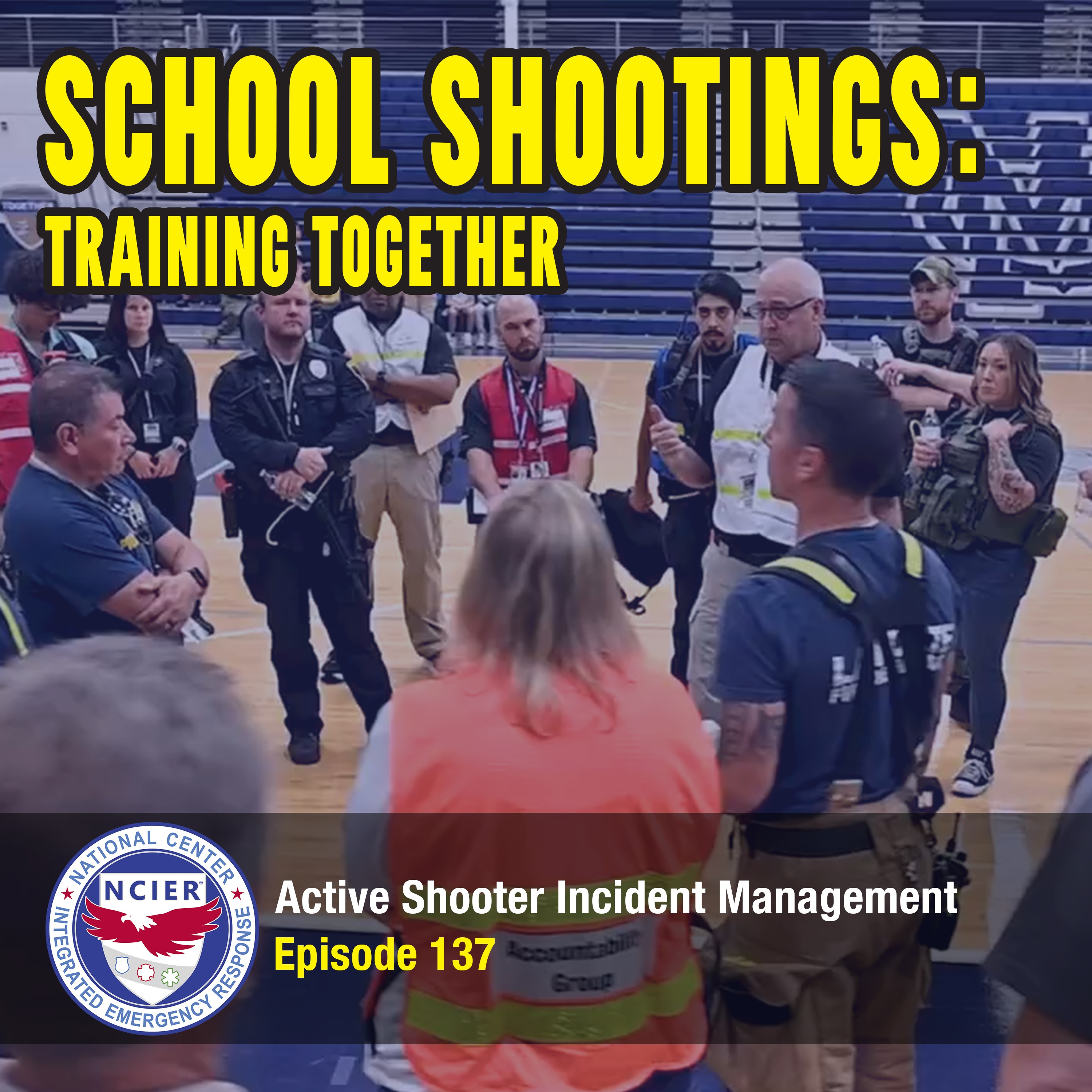
Do not plan in a vacuum. At least once per year, host a mixed‑discipline tabletop exercise on your campus with:
- Local law enforcement (including school resource officers)
- Fire and EMS leaders
- Emergency management officials
- Key school administrators and support staff
Walk through a specific scenario, such as a violent event in the cafeteria during lunch, and answer concrete questions:
- Who can initiate lockdown and how quickly can it be activated?
- Where will police stage, and how will they access the building?
- How will fire and EMS reach the injured, and where will CCPs be located?
- How will the school communicate with the Unified Command Post?
- How and where will reunification occur, and what support will be needed?
Capture decisions, assign follow‑up tasks, and treat these exercises as iterative planning tools.
Step 3: Formalize and Communicate the Reunification Plan
Working with public safety and emergency management partners, schools should:
- Pre‑identify one or more off‑site reunification locations with adequate space, parking, and indoor facilities
- Develop a reunification “go‑kit” that includes rosters, authorization records, printed forms, signage, and basic supplies
- Define transport plans, routes, and traffic control measures
- Prepare template messages to caregivers explaining where to go and what to expect
Critically, parents and caregivers should be educated about the reunification process before an incident occurs. Clear, proactive communication reduces the likelihood that caregivers will rush the campus itself during an event, which can impede emergency response.
Step 4: Develop Internal Expertise and Access External Resources
Sustainable readiness requires internal expertise. Schools benefit from designating and training staff who can:
- Teach SRP and local procedures to new and existing staff
- Participate confidently in Unified Command discussions
- Help design and facilitate drills and exercises
- Serve as liaisons between the school and public safety partners
External resources can support this effort. The National Center for Integrated Emergency Response (NCIER), for example, provides research white papers, infographics, and training programs, including the SSAVEIM curriculum, that schools and agencies use to strengthen their violent event incident management and reunification capabilities. Similar resources from The “I Love U Guys” Foundation and other organizations can be integrated into local plans.
Conclusion
Protecting students and staff from violent events requires more than locked doors and well‑intentioned drills. It demands a unified, realistic understanding of how such events unfold, how public safety professionals respond, and how schools fit into that response as full partners.
By aligning classroom actions with the Standard Response Protocol, adopting an incident management framework such as SSAVEIM, planning reunification in detail, and building internal expertise supported by external resources, schools can move from procedural compliance to genuine readiness.
The tools and frameworks exist. The responsibility to connect them into a coherent, community‑wide strategy rests with school leadership and their public safety partners, so that if the unthinkable happens, the school community is as prepared as possible to protect, rescue, and reunify those in its care.
Endnotes
- Sandy Hook Advisory Commission. (2015). Final report of the Sandy Hook Advisory Commission. State of Connecticut.
- ASIS International. (2017, November 16). School lockdown procedure prevented tragedy in Rancho Tehama. In Security Management online exclusives.
- Marjory Stoneman Douglas High School Public Safety Commission. (2019). Marjory Stoneman Douglas High School Public Safety Commission initial report. Florida Department of Law Enforcement.
- The “I Love U Guys” Foundation. (2021). Standard Response Protocol K‑12 (SRP) operational guidance. The “I Love U Guys” Foundation.
- The “I Love U Guys” Foundation. (2021). Standard Reunification Method (SRM) K‑12 operational guidance. The “I Love U Guys” Foundation.
- National Center for Integrated Emergency Response. (2026). School Safety and Violent Event Incident Management (SSAVEIM) framework [Curriculum documentation]. National Center for Integrated Emergency Response.