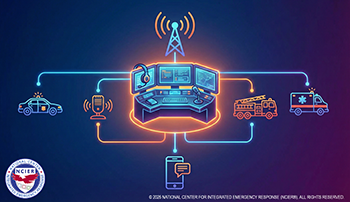
The Dispatch Center as the Initial Intelligence Hub
During a hostile event, the dispatch or 911 center is the primary conduit for information flowing from the public and initial responders to the command structure. Its ability to process, verify, and disseminate intelligence is critical to the incident’s outcome.
Receiving and Relaying Critical Information
The initial moments of a response are defined by the quality of communication between the first arriving officer and the dispatch center.
- Initial Size-Up: The first arriving law enforcement officer’s primary communication duty is to deliver an “LCAN report” (Location, Conditions, Actions, Needs) to dispatch, providing the first clear picture from the scene.
- Civilian Reporting via Text-to-911: Civilians on scene are a crucial intelligence source. NCIER® Instructors advocate for the use of text-to-911, which is now available in many areas. A simple text message can relay vital information that the 911 center can pass to responders, such as:
- Precise location within a building.
- The number of uninjured survivors.
- A basic triage count of the injured, e.g., “three wounded who can walk (i.e., green) and two who cannot/aren’t moving (i.e., reds)”).
- Validating Caller Intel: Dispatch often receives multiple calls with conflicting information. It is critical for dispatch to continue relaying this intelligence to field units, even if it contradicts what responders are seeing on the ground. NCIER® Instructors highlight incidents where responders disregarded dispatch intel, to their detriment.
Synthesizing Chaos in Complex Attacks
In fast-moving or multi-site attacks, the dispatch center becomes the strategic focal point for understanding the broader scope of the incident.
- Recognizing Connected Events: A key insight from NCIER® Instructors is that a mobile attacker or a coordinated attack creates “chaos in the dispatch center.” However, this chaos also provides an opportunity. The dispatch center is identified as the “most likely first opportunity to piece together... that these things are connected.”
- The Role of Supervisors: Dispatch supervisors, who have a broader view of incoming calls across a jurisdiction, are positioned to hear multiple reports and recognize patterns that indicate a single, mobile threat or a coordinated, multi-location attack.
- Inter-Agency Communication: In such events, dispatch centers must communicate with other dispatch centers or regional dispatch hubs to disseminate information about the suspect’s description and vehicle, preventing further attacks.
Facilitating Command and Control
Dispatch provides the essential communication linkage that allows incident command to be established and function effectively.
Establishing the Response Framework
From the outset, dispatch facilitates the creation of the incident command structure.
- Locating Command: The first arriving Fire/EMS supervisor is directed to call dispatch to determine the location of the law enforcement Command Post.
- Resource Management: Dispatch is notified of the designated Staging Area location and may be called upon by the Transport Group Supervisor for hospital capacity counts.
- Standardized Dispatch Packages: To avoid an inadequate initial response, NCIER® Instructors suggest that a “standard response package”—a predefined minimum number of law enforcement, fire, and EMS units and supervisors—should be dispatched automatically when a call reaches a certain threshold (e.g., reports of multiple people shot).
Managing Radio Communications
Communication is consistently cited as a major challenge in after-action reports, and the underlying systems are often a dispatch-level responsibility.
- Systemic Failures: NCIER® Instructors note that communication issues are a common topic in after-action reports, with one speaker exaggerating they appear “a couple thousand times.”
- Technical and Procedural Hurdles: Common problems include:
- The creation of disaster or mutual aid channels that are not programmed into all agencies’ radios.
- Inconsistent naming of channels across different agencies’ radios.
- Improper distribution of encryption keys.
- Failure to practice or train on these shared channels.
- System Overload: During a large-scale event, a 911 system can become overloaded, resulting in calls not being answered.
Integration with Specialized On-Scene Functions
Effective incident management involves integrating the dispatch center with specialized field units to enhance their capabilities.
Role in Hostage Negotiations
When an active shooter event transitions into a barricaded hostage situation, the dispatcher may become the primary negotiator.
- First Point of Contact: A dispatcher is often the first person to speak with the suspect and may build an initial rapport.
- Supporting the Negotiation Team: A recommended practice is to send a trained negotiator to the communication center to act as a “secondary.” This allows the negotiator to provide guidance and feed intelligence to the dispatcher, who can continue the conversation without an abrupt change that might agitate the suspect.
Supporting Intelligence Operations
The flow of information into the dispatch center makes it a critical asset for the Intelligence Section.
- Embedding Personnel: NCIER® Instructors strongly advocate for embedding an investigator directly within the dispatch center during a critical incident.
- Real-Time Analysis: This allows for the immediate analysis of incoming 911 calls, text messages, and other tips, enabling the intelligence team to develop a clearer picture of the event as it unfolds.
Modern Technology Integration
Modern communication and alarm technologies can be integrated with dispatch systems to improve response times and situational awareness.
- Automated CAD Alerts: Alarm systems can now send information directly to a dispatch center’s Computer-Aided Dispatch (CAD) system, providing precise, geolocated data on the threat.
- Mass Notification: Tools like reverse 911 calls can be used to issue public alerts and instructions during a crisis.