NCIER®
Infographics June 13, 2024

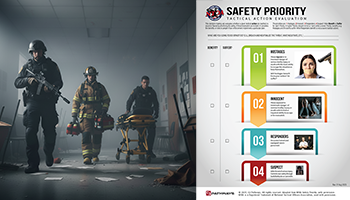
NTOA Safety Priority

Executive Summary

"This document details the Safety Priority decision-making model used by law enforcement to evaluate tactical actions based on a strict hierarchy of life safety: 1. Hostages, 2. Innocent Bystanders, 3. Responders, and 4. Suspects . The framework functions as a risk mitigation tool where decision-makers assess if a proposed plan causes higher-priority groups to "suffer" while lower-priority groups "benefit," establishing that those with the least control and highest danger must be protected first. Adapted by C3 Pathways from NTOA doctrine, the guide emphasizes that these safety priorities strictly outweigh mission objectives (such as arrests or evidence preservation) during critical, evolving incidents."

Key Takeaways

  • The hierarchy is Hostages, Innocent, Responders, then Suspects.
  • Safety priorities always outweigh mission objectives and drive decision-making.
  • Higher priorities must not suffer while lower priorities benefit.
  • Rankings rely on an individual's potential jeopardy and control.
  • This tool evaluates if a tactical action is sound.

This document outlines the Safety Priority tactical action evaluation model, a decision-making framework adapted by C3 Pathways from the National Tactical Officers Association (NTOA) doctrine . Its primary function is to guide law enforcement command and line-level personnel in evaluating whether a specific plan (action or inaction) is ethically and tactically sound during critical incidents. The model asserts that safety priorities must always supersede mission objectives—such as preserving evidence, arresting a suspect, or protecting a crime scene—to prevent decision-making errors during chaotic, rapidly evolving situations.

The framework establishes a rigid four-tier hierarchy based on an individual's potential jeopardy and their inability to control the outcome; entities with less control and higher danger are ranked higher. The priorities are ranked as follows:

  1. Hostages: Those in imminent danger with the least ability to escape or help themselves.
  2. Innocent Bystanders: The public who face danger but have limited or impaired ability to evacuate.
  3. Responders: Trained and equipped public safety personnel (SWAT, Fire, EMS).
  4. Suspects: Individuals who control their own safety through lawful behavior or surrender.

To apply this model, decision-makers utilize a "Benefit vs. Suffer" checklist to assess a proposed course of action. The fundamental rule governing this evaluation is that a higher-priority group must not incur harm ("Suffer") solely to provide a benefit to a lower-priority group. For example, a tactical plan is considered unsound if it allows Hostages or Innocents to suffer in order to provide a benefit to Responders. This logic ensures that risk mitigation principles remain congruent with legal and ethical standards, enforcing that the safety of the most vulnerable populations drives the decision-making process rather than the mission objective itself.
Frequently Asked Questions

The hierarchy is ranked as follows: 1. Hostages/Victims, 2. Innocent Bystanders/The Public, 3. Public Safety Personnel/Responders, and 4. Hostage Taker/Suspect .
Entities are categorized and ranked based on their potential jeopardy (danger) and their ability to control the situation's outcome. Those with higher danger and less control rank higher.
A sound tactical action ensures that a higher Priority group does not incur harm (suffer) simply to provide a benefit to a lower Priority group.
In critical situations, Safety Priorities must never be inverted or disregarded; they always outweigh the mission objective (such as arrests or evidence preservation) and drive the decision-making process.
The National Tactical Officers Association (NTOA) designed the Safety Priorities to provide a model based on sound doctrine, law, policy, and ethics. C3 Pathways created the infographic to illustrate this model.

Top

Find the Perfect Training Class For You