
NCIER®
Glossary October 15, 2026 • 1 min read

Evacuation Care

Definition

An effort is being made to move the casualty toward a definitive treatment facility. Most additional interventions during this phase of care are similar to those performed during normal EMS operations. However, major emphasis is placed on reassessment of interventions and hypothermia management.

Discussion

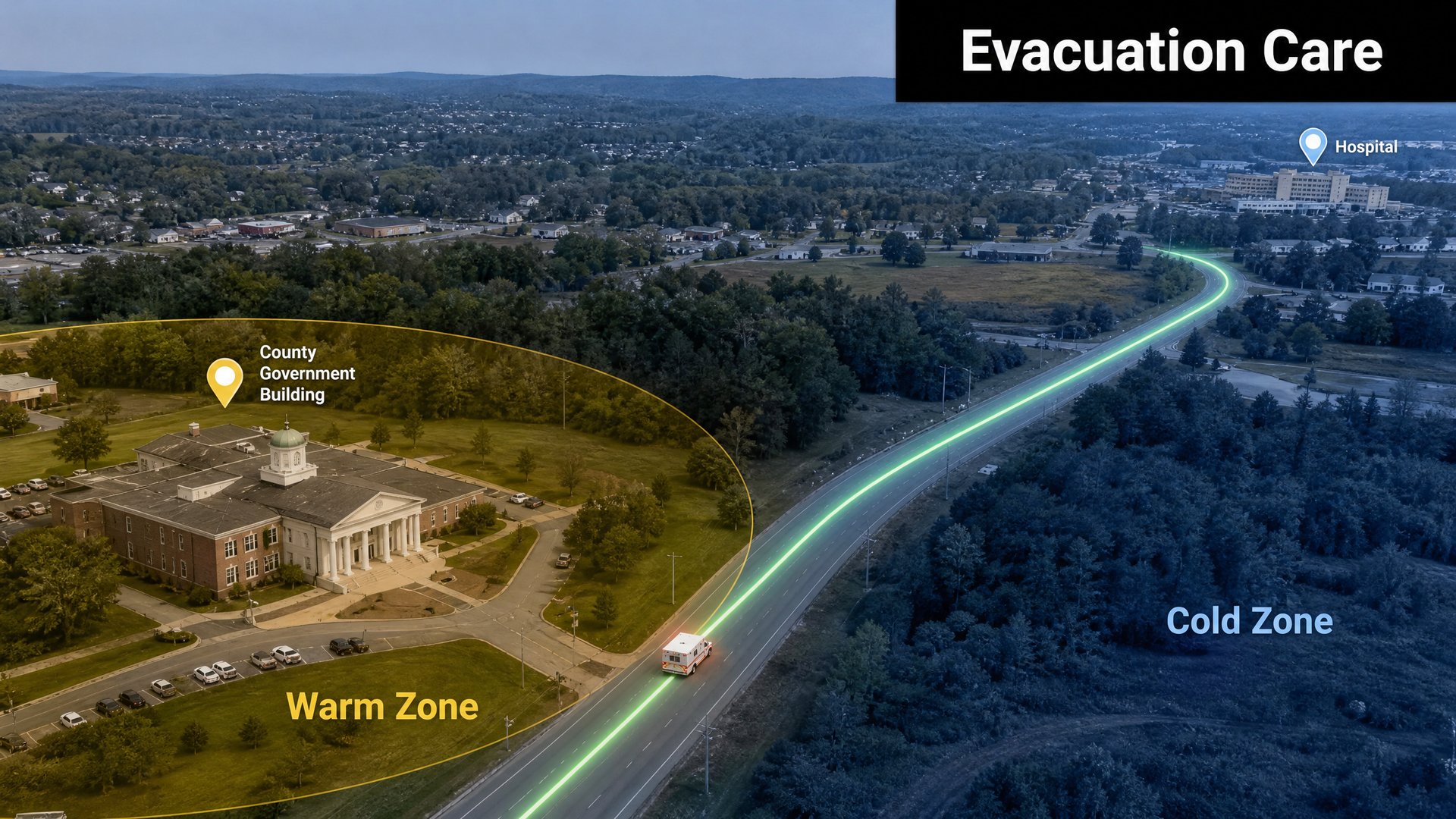
Aerial view of an ambulance leaving the Warm Zone around a county government building on a highlighted route to the hospital during Evacuation Care

In an active shooter incident, Evacuation Care refers to the ambulance transport phase of patient care. In most jurisdictions, treatment is governed by local EMS protocols. C-TECC also provides guidance for appropriate Evacuation Care treatment.

C-TECC guidance for Evacuation Care includes the following items, which local EMS protocols may adopt or modify:

  • CPR may be considered if transport is under 5 minutes to the receiving facility
  • Spreading patients across receiving facilities so no single hospital is overwhelmed
  • Head-up 30° positioning for suspected TBI (Traumatic Brain Injury) when the patient is not in shock
  • Chest tubes and repeat needle decompression
  • Finger thoracostomy in traumatic arrest
  • Lung-protective ventilation
  • Selective spinal motion restriction, with full restriction not recommended for penetrating face/neck trauma and high suspicion for blunt trauma over age 65
  • Formal tourniquet relocation, with four downgrade criteria
  • Damage control resuscitation with an SBP target of 80–90
  • Herniation management: 3% hypertonic saline (3–5 cc/kg), mannitol (1 g/kg), and targeted hyperventilation (PaCO2 30–35)
  • Seizure prophylaxis
  • Peripheral nerve blocks
  • Fixed-dose ketamine (25–50 mg)

Sources: C-TECC First Responders with a Duty to Act (2024) and C-TECC BLS/ALS Clinicians (2025).

Author
Lead Instructor
Reviewed By
Lead Instructor
Last updated:

Frequently Asked Questions

In an active shooter incident, Evacuation Care refers to the ambulance transport phase of patient care.
In most jurisdictions, treatment is governed by local EMS protocols. C-TECC guidance includes: CPR may be considered if transport is under 5 minutes to the receiving facility; spreading patients across receiving facilities so no single hospital is overwhelmed; head-up 30 degree positioning for suspected TBI (Traumatic Brain Injury) when the patient is not in shock; chest tubes and repeat needle decompression; finger thoracostomy in traumatic arrest; lung-protective ventilation; selective spinal motion restriction (full restriction is not recommended for penetrating face/neck trauma, and there is high suspicion for blunt trauma over age 65); formal tourniquet relocation with four downgrade criteria; damage control resuscitation with an SBP target of 80-90; herniation management (3% hypertonic saline 3-5 cc/kg, mannitol 1 g/kg, and targeted hyperventilation, PaCO2 30-35); seizure prophylaxis; peripheral nerve blocks; and fixed-dose ketamine (25-50 mg).

Topics

  • Active Shooter
  • Incident Management
  • C3 Pathways
  • NCIER
  • ASIM
  • Training
  • Fire
  • EMS

Top

Find the Perfect Training Class For You