
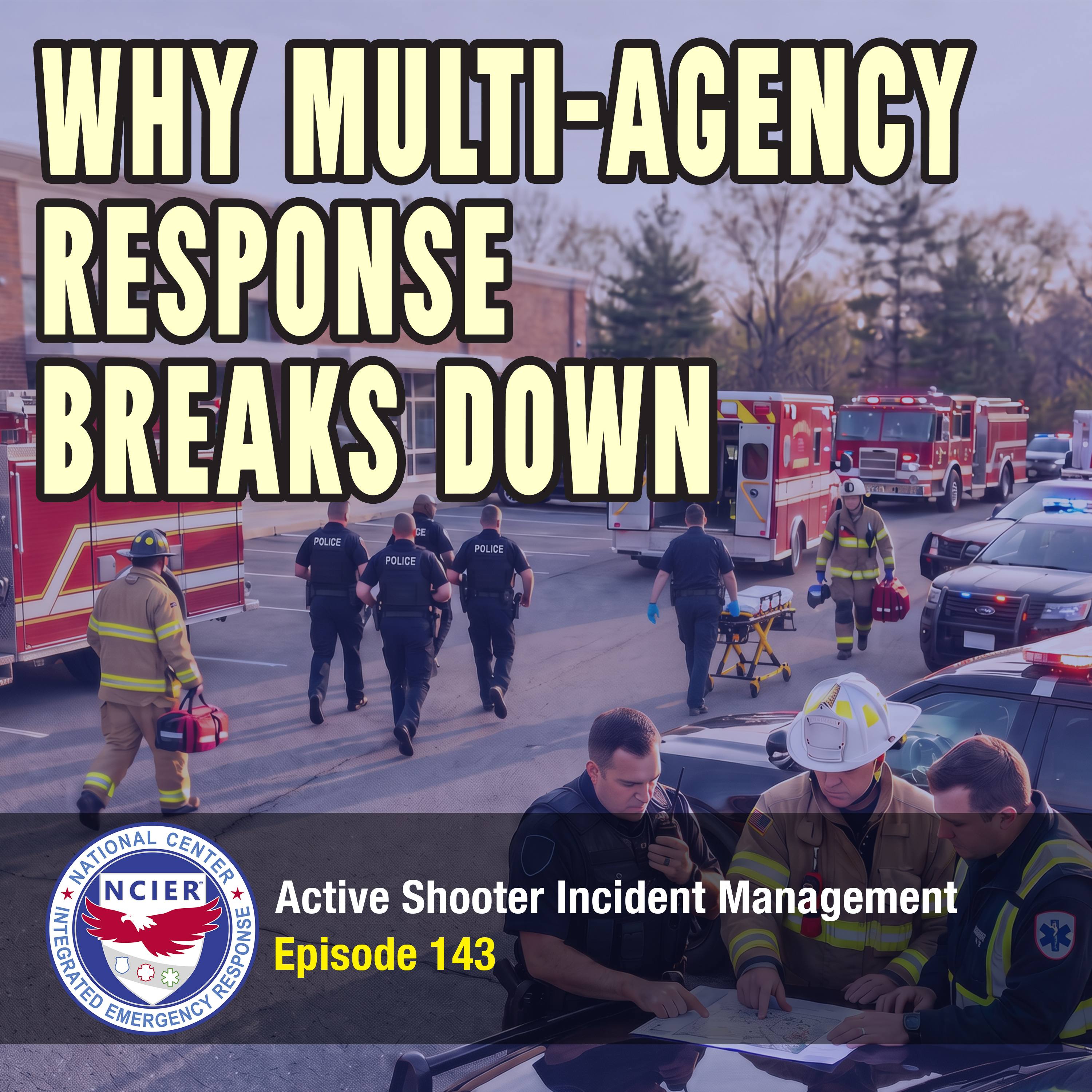
Ep 143: Why Multi-Agency Response Breaks Down
Episode 143
Hosted by William Godfrey
Published Nov 17, 2026
Duration: 27:54
Episode Summary
Police, fire, and EMS work together every day, so why does coordination fall apart at an active shooter incident? Host Bill Godfrey, Police Lieutenant Kami Maertz, and Fire Battalion Chief Brian Beechner explain why these events require each discipline to depend on the others, from warm zone rescue to the Command Post. They cover who leads and who supports, the Command Post mistakes that slow rescue, and how face-to-face communication between Tactical, Triage, and Transport keeps information moving.
Episode Notes
Your agency trained one way. The agency next door trained another. At an active shooter incident, that gap can turn into delays reaching the wounded.
Police, fire, and EMS respond together every day, but in an active shooter event, none of them can do their job without the others. Host Bill Godfrey, Police Lieutenant Kami Maertz, and Fire Battalion Chief Brian Beechner look at where multi-agency coordination breaks down and what has to be in place before the call comes.
Rescue Task Forces (RTFs) entering a warm zone, Casualty Collection Points (CCPs), and Ambulance Exchange Points (AEPs) all depend on law enforcement and fire/EMS sharing information in real time. Agency silos, different terminology, radios that don't patch, and assumptions about how "everyone else" operates turn that dependence into delays.
In this episode:
🔹 Who leads and who supports. An active shooter event is a law enforcement incident, so fire and EMS step into a supporting role. Law enforcement, in turn, needs to let fire and EMS run the rescue, with Tactical, Triage, and Transport working side by side.
🔹 Command Post pitfalls, and where they come from. Fire command runs top-down, but in an active shooter event information comes up from the teams downrange. When that flip doesn't happen, you get role confusion, "wandering commanders," an overdriven radio, the people who know the building left out, and a late start with the Public Information Officer (PIO) while social media fills the gap.
🔹 Why relaying through Dispatch or the Command Post slows rescue, how Tactical, Triage, and Transport act as "human bridges," and how staging can work around radio compatibility problems.
The panel also names the most common assumption about integrated response: that the other agencies already work the way you do.
📋 Before your next multi-agency exercise, download the Active Shooter Incident Management (ASIM) Checklist and send your partner agencies the link so everyone starts from the same page: https://ncier.org/asim/checklist
💬 𝗗𝗜𝗦𝗖𝗨𝗦𝗦𝗜𝗢𝗡 𝗤𝗨𝗘𝗦𝗧𝗜𝗢𝗡: What assumption have you seen derail a multi-agency response in your region? Share it in the comments.
📌 𝗖𝗛𝗔𝗣𝗧𝗘𝗥𝗦
00:00 Why active shooter response is different
02:20 Silos within and across disciplines
04:44 Fire and EMS in a supporting role
07:00 Meeting in the middle
09:29 What a good integrated response looks like
10:25 A shared regional plan and the ASIM Checklist
12:19 Command Post pitfalls and "wandering commanders"
15:34 Getting ahead of public information
17:51 Why communications break down
19:02 Radio patching and fixing it in staging
21:25 Relaying through Dispatch vs. talking face to face
25:42 Lightning round: the biggest assumption
#PublicSafety #FirstResponders #IncidentCommand
View this episode on YouTube at: https://youtu.be/OT4GLKC8cho
Transcript
Bill Godfrey:Active shooter response is a different animal for public safety, and multi-agency response and coordination breaks down all the time. Why? That's today's topic.
Brian, Police, Fire, and EMS, we respond with each other every day. Why is active shooter different? Why is this so hard?
Brian Beechner:
Well, it's just as simple as, you know, what we do. We respond together every single day. We're on the roadway. We go to traffic accidents with law enforcement, Fire, and EMS. We go to an EMS call, but that's not the same as an RTF and making up, you know, law enforcement and Fire and EMS going into a warm zone to start managing the Casualty Collection Point. It's two totally different animals, and you know, do we train on that adequately? Are we working together? Do I have the same terminology when we're going into that warm zone? And those times when we have to have all that preplanned beforehand as opposed to just when we're gonna do it.
Kami Maertz:
This is a unique situation, obviously. This is an active scene still. And so we're asking our fire rescue brothers and sisters to come down into an active scene, into an area that we've created a warm zone out of security, but the area around it's still hot. It's a dangerous situation that we're walking into. The threat level's a lot higher. The unknowns are a lot higher. And we're coordinating that response in a lot of chaos. And so it is a lot different than a lot of the scenes that we go to where the threat level is so high, and we're both working together, right? Because we'll stand outside while you all handle a fire, and you all stand outside while we'll handle a shooting, but we're building that together, and that looks a lot different and we have to treat it a lot different.
Bill Godfrey:
I think that may be the key to hit on is that the normal everyday working together, you do your job, I do my job, and we do it near each other, but in an active shooter event, if we're going to do this right, none of us can do our jobs without the other.
Kami Maertz:
Absolutely.
Bill Godfrey:
Which demands a level of coordination that we don't normally have to do every day.
Brian Beechner:
Right, and usually, if we're on one scene, it's a face-to-face thing. Well, now we're doing radio traffic between inter-agencies, between Fire and EMS, and, you know, are we able to communicate on the radio together? Typically on a scene, we don't. I just say, "Hey, you know, law enforcement officer, can you block that road for me?" It's a lot different.
Bill Godfrey:
And we're gonna deep dive into that, but there's another piece to this. It's not just the multi-discipline Police, Fire, EMS, 911, Emergency Management, all trying to hold hands and sing "Kumbaya." Even within just law enforcement, or just Fire or just EMS, not always smooth sailing, Kami?
Kami Maertz:
No, everyone has their own policies, right? Their own way of doing it, their own procedures, their own terminology. We see it, I mean, the agencies within the other agencies have different terminology, different ways that they handle things, different policies, different ways that they have been trained to react to things. And so all of that comes into the chaos. And so we have to be able to coordinate and work through that chaos and know how to manage those types of scenes. How do we quickly communicate the effective goals, the priorities to everyone, and make sure that we're all operating on the same page?
Brian Beechner:
It's that silo effect. We all wanna, you know, "It's my circle and no one's gonna get into my circle, and I'm not going to let anybody know what's going on in my circle." So we have to kind of break that, and when we do our training, communicate with each other. It's as simple as, you know, getting everybody in the same command post together. Sometimes that's not as easy as it sounds.
Bill Godfrey:
Well, just the idea that because we've established command, everybody's gonna magically fall in line is a little bit of a false belief. I mean, how many times have you seen it where there's a large agency and a small agency that just historically don't like each other, don't work well together? We're now in the small agency's jurisdiction. They're in command, but we don't think very highly of them. And so we don't want to follow... I mean, how often have you seen that be a problem?
Kami Maertz:
Well, it absolutely can. And especially when you're talking about larger incidents. Larger incidents that maybe the overarching county is used to dealing with more than the small entity, however, they are in control, and not stepping on toes, but learning to live in the same sandbox. So coming through and having those communications before the incident ever happens, right? Building those relationships before that ever happens cannot be understated of how important that is to make sure that everyone understands that the goal is to save lives. That's the goal across the board. We're all here for the same reason, but we wanna be respectful and make sure that our specialties are being used effectively.
Brian Beechner:
And even on the Fire and EMS side, sometimes we get caught up with, you know, "I have to be in command." But we have to first realize that this is a law enforcement incident. This is a killing in progress, and we have to help them manage that. And our responsibility is, once they have secured that threat and created an area, a warm zone where we can go into, now I can manage that part of it. But I'm not there to be in command of the entire incident.
Bill Godfrey:
I think that's a really important point that sometimes gets lost is, you know, it's widely regarded that the fire service is really good at incident command, because we've been doing it for a very long time. Yes, the fire service is very good at incident command the way the fire service does it, which is a top-down driven affair. And usually on a very fire-centric topic where they're the domain experts. Now, Fire shows up to a law enforcement incident, Brian, as you said, it's a murder in progress, it ain't really our show. We're the supporting actor, not the star of the show. And most fire service entities haven't had a lot of practice taking that chair.
Brian Beechner:
That is correct.
Kami Maertz:
But I also think it's, on the law enforcement side though, to kind of coincide with that, is it's important for us to realize though that we still really, really need you all there, right? And we cannot expect to show up and do fire rescue's job. And so when we're going in, we're talking about rescue, we have to remember that we have people who are trained to do that, and to not try to do all of it, because I do see that a lot too is that we're like, "Well, it's a murder in progress, it's a crime, we're here for this." And we forget that we have fire rescue personnel on scene, and that they can take care of the rescue portion. We can get them down there safely, but let them do their job. Don't go down there and start just doing all the direct threat care and controlling all of the resources. Make sure that Tactical, Triage, and Transport are standing next to each other, that Tactical and Triage are speaking to each other so that Triage is handling the RTFs, and Tactical is handling the contact teams, and Transport's handling ambulances, instead of trying for Tactical to be running everything, because sometimes you'll see that too.
Bill Godfrey:
Yeah, I agree. And I think to build on that, Kami, the really important piece of this is we really kind of have to meet each other in the middle to get this done. Law enforcement is very well aware that if you wanna do anything with the fire department, you probably need to figure out who the Incident Commander is, and their Command Post and show up and have that conversation. And likewise, the fire service needs to come to terms with the reality that law enforcement has their ways of handling and managing violent events. Just like the fire department knows how to put out a fire, law enforcement has their ways that they're going to deal with a violent event.
But what we really need is just that kind of agreement at all levels, top down to the bottom line, to say, "Okay, we each need to move and meet each other in the middle." The fire department doesn't need to be quite as formal as they are on some of the things. And we need to recognize that the way a law enforcement operation unfolds is a little different than the way a structure fire unfolds or a wildfire unfolds. And likewise, I think law enforcement has to come to terms with, "This ICS thing isn't all evil. It can actually help us do our jobs more effectively and faster."
Kami Maertz:
We control the chaos through it. That management piece controls the chaos. Working together controls the chaos. We reach our goal if we can work together. And it is that training. It's that ASIM training ahead of time. It's that putting in the effort, making sure we're having those conversations. And I also think when you're working next to each other that you start realizing what you do really well and what I do really well, and how do we use that to complement each other and to be able to get the mission accomplished quickly.
Brian Beechner:
I think the goal is this isn't the first time we've worked together. We've trained together. If I pull up into a Command Post and I'm the fire EMS, if I assume the Medical Branch, and Kami is the Incident Commander, and we've worked together before, I can say, "Hey, Kami, I'm here. What do you need?"
Kami Maertz:
And actually speak, right?
Brian Beechner:
We can speak together. And if you can call somebody on a first-name basis, when you pull up to the Command Post, you're ahead of the game. You're starting to control that chaos. And that's really important, because if you're not controlling the chaos, that chaos is just that snowball that's just gonna keep going downhill and getting bigger.
Bill Godfrey:
So let's pull on that thread for a second. What does good look like? What does a good integrated response look like?
Kami Maertz:
Communication. That's the main thing. Is that you can't both just be standing next to each other. You have to be facilitating together. You have to be communicating. You have to be saying, "How can I help you? How can you help me? How are we going to work this response with all the multi-disciplines that are down there? How are we effectively actually making that work?" Because you see a lot of times where one person is like, "This is mine, and I'm gonna stay right here, and I'm gonna stay in my lane," but they almost overstay in their lane. They have to have that communication piece, and it's vital to be able to succeed in the incident.
Brian Beechner:
And I'll add trust. It's the communication and trust. I have to trust that I've given you this assignment or this task to get this done. And I have to trust that you can do it, and I can't micromanage you doing it. Because then I'm just overstepping my bounds. And trying to control the whole incident. And then things are gonna get lost on the backside.
Bill Godfrey:
And I think for me, there needs to be a plan that everybody in this regional response is on the same page. And that page doesn't need to be 100 pages of detail, but two, three pages that everyone has agreed to, this is what we're gonna do. This is the terminology set we're gonna use. This is how this is gonna unfold. And so the first, you know, handful of responders, they know when they go directly to the scene what their role is. The follow-on responders know to be listening to get told to go to a staging area, because they know they're not going directly into the scene. They're gonna go to the staging area and they're gonna get an assignment that both law enforcement, Fire, EMS, whether it's separate or together, they have roles that are gonna come together. We know we need to fill those roles. We know we need a Command Post. We know we need people in charge to be able to do the communication, to be able to have that trust. And that sounds like, well, I don't know if that sounds easy to do or not. It's not easy to do.
Brian Beechner:
It's not easy to do.
Kami Maertz:
There's a formula for it already we should know, right? It is difficult when everything's going on, especially, in the chaos of everything, people wanna take control. We're all, you know, type A. We want to take control. We wanna control everything. And so it's difficult. It's much easier to say on paper, "This is what we're going to do." But like everything else, it happens and everyone's like, "Nevermind, plan's out the window. We're gonna do this."
Brian Beechner:
I'll even throw out there, I mean, we have the ASIM checklist. And that ASIM checklist kinda gives people the little areas, saying "This is your lane in the checklist." You know, if you're one of the first four arriving, you're the Contact Team. There's your little lane. When you're the first arriving supervisor, this is what you're gonna do. This is your lane. It gives you a little bit of a guide. So even if we haven't really worked together, and we all are utilizing this ASIM checklist, we're kind of all on the same page. At least we should be.
Bill Godfrey:
All right, I'm gonna to pull on two threads here. So, you both talked about communication and command. So let's say, okay, we've generally got agreement that the whole region's gonna do it this way. We got a Command Post. How do things go wrong in the Command Post? Let's talk a little bit about the common pitfalls in the Command Post.
Kami Maertz:
I think one of the biggest things is not paying attention to what their role is. Not understanding the job of Command, what Command's responsible for, what Tactical, Triage, and Transport are responsible for, what the Contact Teams are. And so it's trying to do everyone else's job except for yourself, because it's comfortable, it's safe to do those jobs. But it's not what needs to be done. There's a lot that goes into the Command Post.
Brian Beechner:
I could just take the low-hanging fruit of communication, but that's always easy. But I would agree the Incident Commander needs to understand to stay in your lane is what I like to call it. You know, trust the people that are down range, the Tactical, Triage, Transport, they're doing their job. And if I'm trying to micromanage that, and trying to get into the weeds of everything else and the tactics of what's going on, then I'm missing what's happening in the Command Post.
Bill Godfrey:
And I think to both of your points, when you get an Incident Command Post, and I say that to incorporate not only the Incident Commander, but also the Law Enforcement Branch and the Medical Branch, when you get an Incident Command Post that gets a little bit of role confusion, they tend to overdrive the radio, and try to drive it from the top down. We most commonly see this, Brian, on the Fire and EMS side. Because that's how Fire does command, is a top-down driven affair. So they're used to barking orders from the Command Post, which in an active shooter event that is flipped. It's coming up at you, not going down from you. And so I see that as an area that breaks down. The wandering commanders.
Brian Beechner:
The wandering.
Bill Godfrey:
The wandering commanders. Where you want to get a spike and a hammer, and put them on actually put them on a leash and nail them to the ground.
Kami Maertz:
Take their radio.
Brian Beechner:
Put them on a leash and take their radio.
Bill Godfrey:
Take their radio away so that they actually have to talk to the other people around them rather than listening to the radio. I also think one of the things that can go wrong at the Command Post is not, in a way, I guess it's role confusion, but not understanding the information that they need to be sharing with each other, and kind of going off Crazy Ivan and making decisions and issuing instructions and direction that's out of sync with the others. What are the other kinds of things that you guys have seen go wrong in the Command Post?
Brian Beechner:
The one thing, not utilizing personnel from whatever it is, a building or an office or a school or an airport, or wherever it is, if I don't bring that personnel into my Command Post, a lot of times we get tunnel vision like, "Hey, I'm in Command. I know everything." We don't know everything. I need a supervisor or some type of an administrator that knows this particular building. If it's at a shopping mall, bring in someone from the shopping mall that knows all the ins and outs of that shopping mall. So it's a resource for me to go to to get information that I may not have.
Kami Maertz:
That intel piece is very, very important in that. I think it's also, you know, one of the big things for Command is communicating with the public. So it's going through that PIO, and not wanting to talk to that PIO, right? There's a lot of Incident Commanders who don't want to. They're like, "I don't wanna be on the news. We'll let the next guy do that." But that information, and gathering that information, making sure they're working with that PIO, speaking to your community is so valuable. So, you know, they have the right to know what's going on in their community, and that they're safe, and what's going on. And so it's remembering that that's your job, that is one of your functions, and making sure that you're not avoiding that, that you're having that communication piece.
Brian Beechner:
And getting that out quickly.
Kami Maertz:
Getting it out very quickly.
Brian Beechner:
Because if you don't put it out quickly, the information that you want, somebody's gonna make something up and put that stuff out there. Whether it's the general public or the news agency.
Kami Maertz:
And that adds into the fear, right? Which was likely the reason for the incident is to create that fear. And that's what we're trying to avoid. We want them to know, we want the public to know that they're safe. We want them to know that we have a plan, we're working through the plan, and that we're working to a point that we can get more and more information to them. But speaking to them early, I do think.
Brian Beechner:
And the general public wants direction. Then the direction may be, "Hey, stay away from this area." Or, "I need you to go here, or do this." And they seek that information.
Bill Godfrey:
I think that's especially critical in school events and attacks on schools. The speed at which the kids are going to communicate over social channels to not only the parents, but to their friends and communities and the other schools, it is, I mean, there's speed of light as a known measurement. And I don't think it's quite as fast as that, but it's pretty doggone close. And it's amazing what they can get right and what they can get wrong. And so one of the responsibilities of Incident Command early in the incident is to get a PIO that starts to get their arms around that. Because if you let that go run amuck, even for an hour, without a response or a statement, you're creating the beginning, instead of catching the snowball when it's the size of a golf ball, you're trying to deal with it when it's the size of a boulder and it's going 40, 50 mile an hour.
Kami Maertz:
You'll be reactive the rest of the time.
Bill Godfrey:
You just never really get ahead of it. Let's talk a little bit about why communications break down. And I wanna split this between the inter-agency communications and the inter-cross-discipline communications, both from a technical level and a face-to-face level. What are some of the things that go wrong, just within the law enforcement community, with communication on an active shooter event when you're trying to manage this thing?
Kami Maertz:
Well, I think one of the first things is, and we teach it and teach it and teach it, but it's that first arriving officer giving that initial brief. So it's the first five minutes of this incident that's gonna determine the success. So it's making sure that they're giving out the right information, making sure that all the other responding units know what they're walking into and are prepared for it. But it's beyond that. It's growing that communication, making sure that we're getting that confirmation back and forth. There's a lot of people on the radio. It's making sure that we're utilizing our radio for law enforcement purposes. When our fire rescue guys get there, they're utilizing the fire rescue radio for medical purposes and so that we're making sure that we're not overwhelming those communication pieces just from the technical standpoint, just from using the radio, and just from the information that we can get out there.
Bill Godfrey:
How much of an issue is it still for you and law enforcement with the different radio channels? Sometimes different systems, different frequencies, things like that. How big of an issue is that do you still see across the country?
Kami Maertz:
We're getting better, obviously, but there is still the patching, and we have to make sure that we know that there's somebody who can patch, and especially in smaller agencies. I work for like a midsize agency, and so our technology has advanced pretty far. I can tell you in a lot of smaller agencies though, and they're coming out to help as well, their radios may not patch into our system. So it's making sure that we're preparing for that. How are we going to do that? Are we making sure that that person is with a law enforcement officer who does have a radio that's going to be able to communicate? Otherwise, we might not be sending them down range. We're gonna utilize them at some other position that they can't have a communication, but it's making sure that everybody can communicate downrange. But there is radio channels that we can communicate with everybody, but it depends on what entity is coming and what radio they have to be able to communicate.
Bill Godfrey:
Yeah, and I think the classic place that people miss the opportunity to solve that is in staging. You know, if you've got some officers that have radios that are not on the right channel, you just mix them in with teams of officers that do have radios on the right channel, and the problem just kinda goes away.
Kami Maertz:
And make sure they know to stay together, right?
Bill Godfrey:
Yeah, never split the company. We were talking about that earlier.
Kami Maertz:
Stay together.
Bill Godfrey:
Brian, what about on the Fire and EMS side? What are some of the challenges that we still run into and see?
Brian Beechner:
I think the challenge is we still think there's a lot of assumptions. The assumption is that if I have multiple agencies working together, that they work on the same sheet of paper that I work off of. And we don't communicate that. And going back to Bill's point with staging, if I'm an Incident Commander and I have multiple agencies responding into the staging area, it's almost who's the staging manager to say, "Hey, we're all responding together. This is what's gonna happen." And if we're in the Incident Command, we just assume that this ambulance knows that this is how we work. And also not knowing the other capabilities of the other agencies that we have. I may have two paramedics on my ambulance, where Agency X only has an EMT and a paramedic. And if I don't know those capabilities, or find out those capabilities, I'm just starting to lose the game.
Kami Maertz:
Yeah, I agree.
Bill Godfrey:
Interesting. And then on cross-discipline communications, that increases the difficulty on the technology front for radios. Some places are in better shape than others. But in most places here, if you follow the process we've laid out in the Active Shooter Incident Management Checklist, we've got overlapping that allows that critical communication to occur face to face amongst human bridges. Do you still see... Obviously, if they don't get their structure right, then that communication breaks down. And I've seen it flow through Dispatch. We're gonna use Dispatch as the translator to go from law enforcement to EMS. What other breakdowns have you seen when they don't get the process structured right?
Kami Maertz:
I think there's delays in the process, right? If you're not communicating what your needs are, if I'm trying to do everything, and I'm not having those conversations when I'm standing next to the person, it creates a delay in the process. So it creates a delay in rescue, even from the casualty collection point, getting the RTFs down range, getting the Ambulance Exchange Points. I do know on law, when you're talking about talking through Dispatch, as law enforcement, it is a huge switch for us to not call everything through Dispatch. We call everything through Dispatch. We typically do not speak to our supervisors back and forth. We just call everything to Dispatch. Dispatch gets everything. This is gonna look much different for Dispatch. It's gonna look much different for the officers. And sometimes that does get lost in translation. Even, you know, that's part of that training though, and making sure that everyone understands that that's going to look different. But you know, I do think our structure in the training though, where we're having Tactical, Triage, and Transport, having that communication in person saying, "Hey, I'm hearing this on my radio. Are you hearing that on yours?" And getting that double check that everyone's on the same page and that we're not having where you call in, at least in our community even, our dispatchers aren't together. So our EMS dispatch is on another side than our Fire or our law enforcement. So for me to get a fire rescue personnel, I have to call to my dispatch who has to actually pick up the phone and call over to the other dispatch center to have a, you know, delay.
Brian Beechner:
I was gonna bring that up, and thinking about the flow of information. If Kami's Tactical and I'm Triage, and we're talking next to each other, we're talking together. But if now if I'm Triage, and I have to report to Tactical, and I call my fire dispatcher and say, "This is the information I need from Tactical," now that Fire EMS dispatcher has to pick up the phone, call over to the law enforcement dispatcher, that law enforcement dispatcher has to then relay that information to Tactical, and vice versa. And how much of that information that I need may get lost in that translation, as opposed to talking face to face.
Kami Maertz:
And you're also hearing the overbleed of the radios. I think that's another thing is when they're standing together, is I've seen a lot of times where Triage will hear something on Tactical's radio, and they're like, "Hey, they're calling you," or, "Hey, they said this on your radio." It's also that need, right? When you're going through so much, maybe Tactical's overwhelmed at that moment, or Triage is overwhelmed at that moment, it's also having another person that's kind of invested in the goal and is listening to those things, especially when you get up to Command, you get up to Medical Branch and Law Enforcement Branch. Again, they're listening to the radio and they're hearing those needs. And if something is missing, there's somebody else to catch that communication delay.
Bill Godfrey:
And I think just like having to relay through Dispatch, we also see sometimes relay through the Command Post. Because again, bad fire service habit, that's you know, it's a very flat command structure, and everything flows through Command. And so then they bring that habit forward.
Your goal should be to be able to directly reach out and talk to whoever you need to. So for example, if I'm on a Rescue Task Force, and Kami, you're on a Contact Team, and we need to know something, or we need you to help us with something, now I don't have direct radio comms, but if Brian is the cop that's with me, he is on your channel. I can say, "Brian, can you find out from that Contact Team whether we can move? Is the Ambulance Exchange Point secure? Can we do this? Can we?" And now we're not having to use a universal translator. We're running it direct. And that saves time and improves accuracy of the communication.
So let's do a quick lightning round here. Single, common misperception. What's the one that jumps out at you? The most common misunderstanding about getting an integrated response to work right?
Kami Maertz:
I think that it's just going to be easy. I think that everybody, because they've trained their own way, that they think that when they get on scene, everyone else is trained that way, and not having that communication piece ahead of time, not training together and learning, you train much differently than I train. And not even having those conversations, not realizing that the agency next to you has a completely different way of doing it. And so not taking the time to have those communication pieces worked out.
Brian Beechner:
I think the misconception is they know what I'm thinking. So when I pull up into the Command Post, everybody else in the Command Post already kind of knows what I'm thinking, and they're just gonna do what I tell them to do. And that's a huge challenge.
Bill Godfrey:
I think for me, it comes down to habits, which in a way I think is hitting on both of what you're saying, which is interesting. Realizing that the habits that I have, or that my agency has, or my discipline has, are the same habits that everyone else has, or that they even should be the same habits. And the reality is no one has the habits that are needed for everyone to make this work. We need to meet in the middle.
Kami, Brian, thank you so much for coming in to talk about this one. Great topic. For those of you that are out there, if you have any questions on this topic or any thoughts, please reach out to us and let us know. You can hit us up at info@c3pathways.com. If you have any suggestions for future topics, or if there's anything we can do. If you haven't already, like and subscribe to the channel. Thank you to our producer, Karla Torres. And until next time, stay safe.