Ep 137: School Shootings - Training Together
Episode 137
Published Aug 19, 2026
Duration: 29:20
Episode Summary
Lockdown is one step — not a plan. This episode exposes the gaps that appear when schools, law enforcement, fire, and EMS all train in silos, and explains why integrated planning for reunification, communication, and accountability through the School Safety and Violent Event Incident Management (SSAVEIM) framework is the difference between a coordinated response and chaos.
Episode Notes
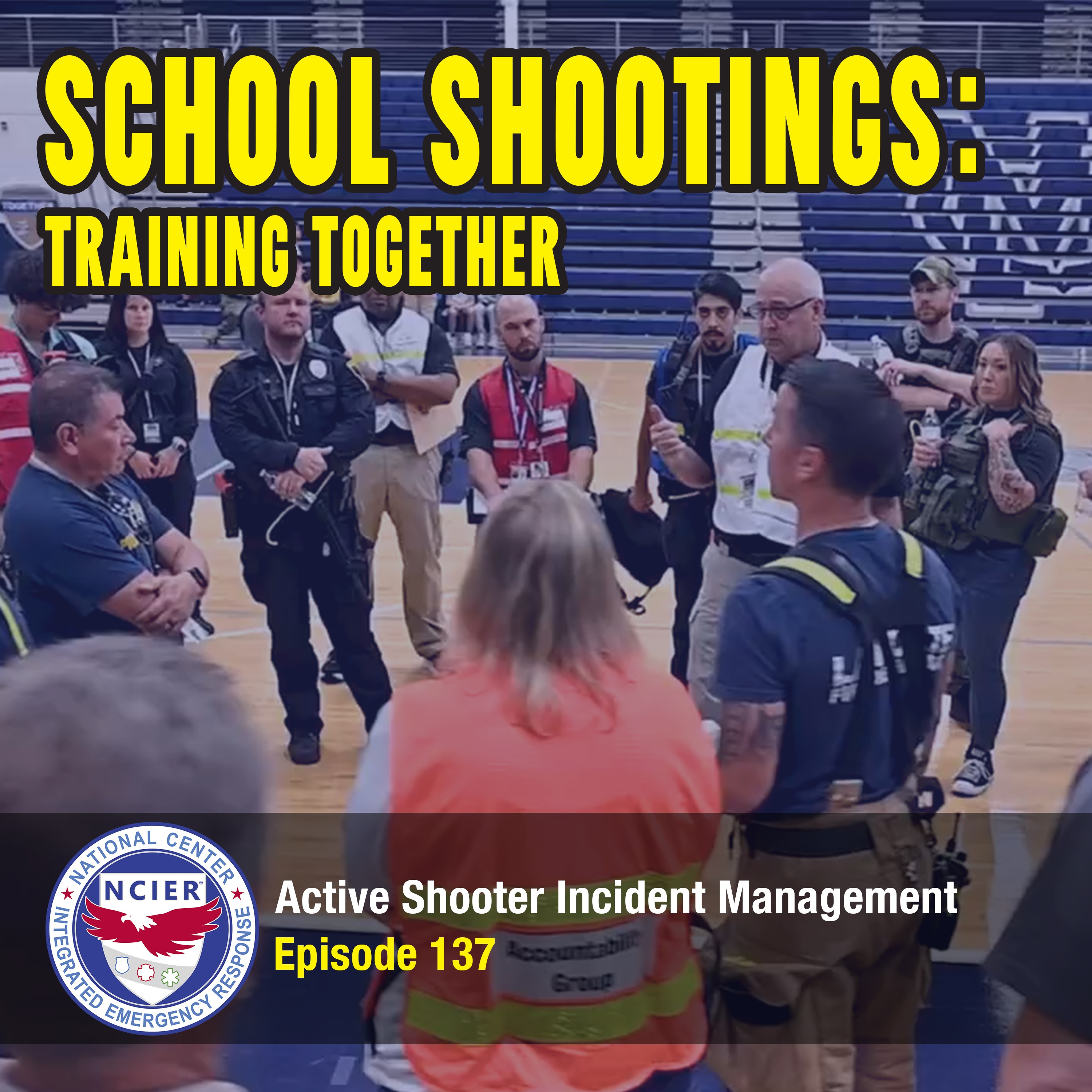
Schools rehearse lockdown drills. Law enforcement trains tactical response. Fire and EMS practice triage and transport. But how often do all of those groups train together? In this episode, host Bill Godfrey and NCIER instructors Kami Maertz and Brian Beechner break down what actually goes wrong when schools and public safety agencies each build their plans in isolation.
The conversation covers:
- Why siloed training creates dangerous assumptions on both sides — schools assume law enforcement "just knows," and public safety assumes reunification will "just happen"
- An inverted-thinking exercise that flips the planning question: instead of asking what should go right, ask what you could do to guarantee failure — and work backward from there
- The communication gap that leaves students locked down for hours with no updates, no information, and no sense of whether they're safe
- Reunification logistics that most plans haven't accounted for — bus availability, accountability at every transition point, custody verification, separating children from the incident area, and campus size
- Public safety blind spots including outdated or incorrect school maps, missing master keys, and unlabeled rooms
- Why a "lockdown" on a playground, in a swimming pool, or inside a cafeteria doesn't look anything like a classroom lockdown — and plans need to reflect that
The episode closes with one common thread: communication and integrated planning — done together, not in parallel.
The School Safety and Violent Event Incident Management (SSAVEIM) course is designed to bring all of these entities to the same table. Learn more: https://ncier.org/ssaveim
View this episode on YouTube at: https://youtu.be/rzFKsYDvip0
Transcript
Bill Godfrey:Schools need to be prepared for a violent attack on campus. But how to get that preparation done? Not as easy as it seems. Kami, why not? What are the problems? What are the gaps?
Kami Maertz:
Well, there's a lot of people coming, right? There's a lot of people coming to respond to the incident. So a lot of times schools focus on lockdowns. That's their procedures. That's how they operationally handle an Active Shooter Event. They're training lockdown drills. But that's one step. And so when we're talking about training, we have to consider all of the people who are coming and how we're going to do the overarching incident management of the actual incident, of what's going on, and we have to train together. I think that's the biggest thing. The biggest operational thing that I see constantly is that we don't all train together. We all train in our silos, and then we expect on game day for everyone to be able to operate as one, and I think that's a miscommunication.
Bill Godfrey:
Yeah, Brian, how big of an issue is that, that the training is done in silos and as a group, police, fire, EMS, emergency management, schools, they're not really sure what right looks like?
Brian Beechner:
Exactly. Like Kami was just saying, we train on all these lockdown drills within the schools, but I can guarantee you that most fire and EMS agencies don't know what that lockdown drill looks like. So that communication piece between the school board system and the fire department, I call it building relationships. The school has to have a relationship with the law enforcement, they have to have a relationship with the fire and EMS agencies within the area. And bring them in, just bring in a supervisor of the fire and EMS department, just to watch that lockdown drill and see the process that it goes on so when something does happen, I'm just that much more ahead of the game.
Kami Maertz:
Yeah, and I also think though that it's important for like schools sometimes think well, like law enforcement's gonna do law enforcement job and I don't need to know what they're going to do. Fire's gonna do fire's job and I don't need to know what they need or what they're going to do. It's vitally important, though, for everyone to know what everyone else's response is. It's important for us to know what the lockdown drills look like, what are they telling the children to do, what are their response, what are their protocols within their school, who's taking charge.
All of those things is very important for law enforcement and fire rescue to know, but it's also important for the school to know what our response is going to look like, that we're going to set up a tactical triage and transport. That's who's gonna control our movement, is that tactical. So everything going down range, everybody on scene is gonna be controlled by a single entity, that's important. What fire rescue is, when they're coming in, where are they going to be at in the school, that you're not just gonna see firefighters walking around, that they're going to be in these Casualty Collection Points and we're going to bring people there. If somebody is injured, that's where they're going to be, so we need to know where they're at. All of those little things, right? The overarching emergency managers and what their jobs are going to be, what does it look like across the board so that we have that communication early on. We all train together. We all know what everyone's trained and responsible for so that when we put the big picture together, everyone's prepared for that.
Brian Beechner:
If we're siloed like that, then the simplest term is they're not familiar with this terminology.
Kami Maertz:
No.
Brian Beechner:
Law enforcement and fire may not be familiar with, "Hey, if the school's in lockdown, what does lockdown really mean to them? If they're holding, what does that mean to them?" And, conversely, on the law enforcement fire side, when I say, "Oh, there's a contact team," or I give them instructors, they're starting to hear RTF or CCPs. To the school board, what does that mean to them?
Kami Maertz:
Yep.
Bill Godfrey:
I think there's, likewise, just as big a misunderstanding on the public safety side about what is actually involved in reunification-
Kami Maertz:
Yes.
Bill Godfrey:
and how complicated that is. I think the schools struggle with that on their own. And if the schools aren't really confident in how to get that done, why in the world does, you know, public safety have this sense of confidence that it's gonna go off without a hitch?
Let's dive in a little bit. Let's talk about what the components need to be. And I'm gonna suggest that we actually reverse this and use some inverted thinking here. Because I think, you know, imagine that you're the school safety person or the school emergency manager and it's your responsibility to kind of come up with this plan. And to some degree there's common components of the plan and to another degree it's all local. So where do you start? And if you're not sure where to start, use this exercise that we commonly use called inverted thinking and say, "Okay, how could we ensure that we screw this up?" So let's run down the list of things that can be goofed up. It's not clear who calls for the lockdown.
Kami Maertz:
Yep.
Bill Godfrey:
Okay, we got the lockdown initiated, locks, lights, out of sight, now what? There's no plan past that. What are the other kind of things that we can make sure that we're gonna goof up?
Kami Maertz:
Well, that no one knows the plan, right? Besides the person who created it, that it was a document that was created and put on a shelf and that nobody's rehearsed it, nobody's gone over it, nobody's looked for the failures within that plan. And so us having a plan and nobody's ever reviewed it, nobody's ever practiced it is going to fail.
Bill Godfrey:
All right, so let's make sure we, if we do create a plan, we don't train anybody on it.
Kami Maertz:
Nobody ever looked at it, yeah.
Bill Godfrey:
It's a super-secret squirrel plan, all right. Brian, what can they do wrong to guarantee that it's gonna go wrong?
Brian Beechner:
Siloed. Absolutely siloed. If we're only exercising this plan within the school system and now we're gonna have all these other agencies coming in, I don't tell the police department, I don't tell the local fire department, I don't tell the local transport agency what our plan is and how that's gonna work, when they do get there, they're gonna be like, "Hey, what am I supposed to do?" And you're like, "You're supposed to know."
Bill Godfrey:
All right, I'll add in let's not communicate with the staff during the event at all. Let's provide no updates. Let's keep them in lockdown for two to three hours until a group of armed, heavily armed law enforcement officers, forcefully kicking the door, scare the crap out of everybody, even though the scene has been safe for two and a half hours. And if they hadn't already gone to the bathroom, they've all just gone to the bathroom on the floor.
Kami Maertz:
Absolutely. Or not communicate with community, right? Not letting the parents know what the process is, what's going to happen, what they should expect, not setting a reunification center, right, so that no one knows what's happening and where to go and what the expectations are after an incident.
Bill Godfrey:
Let's not have a reunification plan at all.
Kami Maertz:
Not at all, yeah.
Brian Beechner:
I think the social media aspect is every school system should have some type of communication plan to get to the parents. And if we're not exercising that communication plan or putting out just, "Hey, there was an incident. Everyone, just stay where you are." Parents are not gonna stay where they're at.
Kami Maertz:
Of course not, no.
Brian Beechner:
They're gonna wanna know. Give parents something to do, give them a goal, give them, "Hey, we're gonna have another update at such and such a time." If we don't do that, parents are just gonna start showin' up at schools and want their kids.
Kami Maertz:
Of course.
Bill Godfrey:
Yeah, and let's make sure that that communication system, whether it's the one we use to communicate over the PA at the school or the one we use to notify parents about inclement weather and release is gonna be delayed, let's make sure that there's one spot, one spot only and one system only-
Kami Maertz:
The only way we can communicate.
Bill Godfrey:
It's the only way we can use it, and if for some reason we can't get to that or it's not working, then that's out of play.
Kami Maertz:
And we don't tell them it's safe. We don't tell them that that's how we're going to communicate before anything ever happens, right? So when it comes across, they don't know if that's safe. They don't know if that's good information or not. That's always really good.
Brian Beechner:
We could also overcommunicate, and we're like, "Hey, as soon as the incident kicks off, boom, here's the reunification site everybody go there." But the reunification site's not even set up-
Kami Maertz:
Giving out too much information.
Bill Godfrey:
With no security.
Brian Beechner:
With no security.
Bill Godfrey:
Yeah, yeah. Let's not tell the teachers, staff, and students what we want them to do in a lockdown.
Kami Maertz:
Yes.
Bill Godfrey:
What is it that they can do? What can they do to keep themselves safe, to keep their friends safe? Let's not tell 'em anything about procedures if they're confronted by a threat. Let's not explain to them ahead of time that they could be in lockdown for hours. What else?
Kami Maertz:
I would say, as first responders, not knowing how the system works or not paying any attention to what the internal regulations of accountability already are within the schools. So we don't use their system they already have in place, or to make sure we have accountability, just disregard all of that. Anything that they've already using.
Bill Godfrey:
No roll calls.
Kami Maertz:
No roll calls. We're not even using it.
Brian Beechner:
More importantly, this is the first time I've ever been in this school.
Bill Godfrey:
Oh, yeah.
Brian Beechner:
This school's been in my-
Kami Maertz:
Never going there. Never go, yeah.
Brian Beechner:
For 30 plus years. But this is the first time I've ever stepped foot in this school. And they're telling me I need to go to room 101. Well, I don't know where that is because I don't have any maps, I don't have any idea other than they're telling me, "Hey, I need you to go down here and make a right, there's room 101."
Kami Maertz:
Yeah.
Bill Godfrey:
Let's make sure that we don't have maps for first responders.
Kami Maertz:
Yes.
Bill Godfrey:
Let's make sure that we don't have keys, master keys.
Kami Maertz:
Yep.
Bill Godfrey:
Let's make sure that they're not color coded, that there's 15 different master keys for the whole campus.
Kami Maertz:
And none of the rooms are labeled.
Bill Godfrey:
None of the rooms are labeled, yeah, yeah. What else?
Brian Beechner:
We talk about ingress and egress out of the school. Let's put all of these cars right here and we only have one way in and one-
Kami Maertz:
Yep, those staging. Everyone just come right in and see how this works.
Brian Beechner:
Yeah, one way in, one way out, and now we've just blocked our one way in and one way out for ambulances.
Bill Godfrey:
Let's make sure we have to carry the injured half a mile to get them onto an ambulance, yeah.
Kami Maertz:
Exactly, yeah.
Bill Godfrey:
Yeah. How about let's not communicate with the parents ahead of time. Let's not tell the parents that we have a plan and what that plan is.
Kami Maertz:
Exactly.
Bill Godfrey:
Look, somebody said it earlier, it's not like the parents are necessarily going to abide by the rules and follow the plan, but life could be a lot easier if the parents knew what the plan is. So let's just not tell the parents anything and keep them in the dark, that would end well. Sarcasm.
Brian Beechner:
Give the parents, "This is the reunification process. When you show up to that reunification site, you're not gonna have access to your kid immediately. There's a process that we have to go with." And as a school system, we have a responsibility to get Johnny back with his parents, and the right parents, we don't, you know, give Johnny back to somebody who doesn't have custody of Johnny.
Kami Maertz:
Yeah.
Bill Godfrey:
Let's assume that the school system can magically produce 30 or 40 buses on demand.
Kami Maertz:
Yes. All of them, all the contractual bus drivers are gonna come back-
Bill Godfrey:
Exactly.
Kami Maertz:
And they're gonna show up and there's nobody else that's gonna need to go home that day either in the entire county, right?
Bill Godfrey:
Yeah, 'cause buses aren't like EMS. They have more buses than they need and more drivers than they need, you know, again, sarcasm here.
Kami Maertz:
Yes, of course.
Bill Godfrey:
So let's not include that piece of it. Let's not include the local emergency manager.
Kami Maertz:
Yes, we can do it all by ourselves.
Bill Godfrey:
Yeah, we don't need emergency management, you know? I think we got a pretty good list goin' here.
Kami Maertz:
Yeah.
Brian Beechner:
Yeah, right.
Bill Godfrey:
Yeah, all right, so let's pivot from the list of how to screw this up and kinda talk about what are the common failure points. And my first one would be, we opened with talking about lockdown. Yes, lockdown's important. It is one of the five protection steps under the Standard Response Protocol, locks, lights, out of sight. We have commonly seen, in fact, we've done two podcasts and interviews, I've done interviews with students, and they're like, "Great, what do I do now?"
Kami Maertz:
Yes.
Bill Godfrey:
We've had students that have been told that there's a bucket of rocks kept in the classroom, and that if they're confronted by an attacker to throw rocks or throw books. That's probably not the greatest guidance to give. So recognize that when you're working on your lockdown, you need to provide additional guidance from the staff. The teachers need to get a list of who's in the room because you're probably gonna be missing somebody and you may have somebody that you're not supposed to have because they ran into your room from the hallway. What are some of the common pain points?
Kami Maertz:
I think even for lockdowns, I think it's important across every school within the community, they all have the same lockdown drills, right? Because what we realize is some lockdown drills tell the students, "Go here, go there," whatever direction it is, right? Hide, whatever it is, and where they're supposed to go do that at is different between the schools. But for our response, as law enforcement, that can change things for us. We need to know there's uniform across of what their lockdown drills and what it's gonna look like. Now, are there gonna be situations where the child didn't respond, how they were taught? However, if you teach 'em, they'll do what you teach 'em to do, but it has to be uniformed. I think that lockdowns look different at different schools, even though they're not really supposed to. They're not training to the same effect across the schools. And when you start actually going to the schools and learning what the lockdowns are at each school, that's, as law enforcement, though, that should be our job. We should be going and overseeing that. We should be teaching and learning of what they're doing and going in and looking at tactical failures from our side. Where are we gonna fail when we respond to this because of their location needs, right? Whether it's the marking on the door or the maps that are preset.
I know, years ago that, you know, we went to a location and the maps were all wrong and the maps for the schools are wrong. That, for tactical, can be, you know, a serious failure. If we're looking and saying, "You need to go and clear this building," and that building never existed, if it was something that was maybe supposed to be built and just never was, you know, funding fell through, whatever it was, that's important. If it's a two-story building, that's important. So it's working together, but it's also, you know, just making sure that all of those things are worked out beforehand.
Brian Beechner:
And I think, too, with, you know, you're gonna have some students that are not gonna be in the classroom, like Bill just mentioned, and are we communicating with those students? And if you find yourself in the hallway and we call lockdown, what are you gonna do? If you're in the bathroom at that, if the student's in the bathroom, what's that student gonna do? And then if they are told to get into the closest classroom, now we have to communicate with that teacher, "Hey, I'm Johnny. I'm not supposed to be here." And when that teacher's taking accountability, who else is in that classroom that's not necessarily-
Kami Maertz:
Yeah, and how does it get back up, right?
Brian Beechner:
And how does that get back up the chain?
Kami Maertz:
So that we know for accountability. Accountability's incredibly important.
Brian Beechner:
Yeah.
Bill Godfrey:
To both of your points, I think it's also important for planners to recognize that a lockdown on your campus is not going to be the same everywhere on the campus. How you're gonna lock down a building of classrooms is different than the action you may need to take to lock down your cafeteria or your auditorium or-
Kami Maertz:
Yes.
Bill Godfrey:
the football field.
Brian Beechner:
The playground.
Bill Godfrey:
Or, yeah, the playground, the gym.
Kami Maertz:
A lot with playgrounds, yes.
Bill Godfrey:
The performing arts center, the baseball fields, the swimming pool, that was one, you know, I thought was a very, very interesting observation from the interview we did with the student from FSU, from that shooting. She said, "You know, there were people in the swimming pool. What are they supposed to do to lockdown? How is that supposed to work?" And so I think it's really important for planners to recognize it's not as simple as just a shouting lockdown, that could be contextual and the procedures that need to be followed may differ.
Kami Maertz:
Yeah.
Brian Beechner:
And it may include, if you're in this area, we just want you to run away.
Kami Maertz:
Yes. But I think it's also when you're making those plans, like even for your school admin side, right, bringing in your law enforcement, bringing in fire rescue, setting it up and looking at it and saying, "Okay, operationally, I can get an ambulance in here. So if we can try to set a Casualty Collection Point as close as we can to here," whatever it is. I know school assembly's a lot, right? Where can we drive the buses, bring in your transportation people, have them look at it. I know that there was a time where we did it and we were like, "Okay, well, we'll bring the buses here." And the transportation guy was like, "Absolutely not. You're never gonna get a bus to turn around there." But we're not going to know that. So everyone coming to the table and looking at the plans and saying, "How is it gonna fail? What is in this plan that is going to fail? How are we going to do it wrong?" Not looking at it and saying, "This all looks right. What looks wrong in it? How are we gonna fail?"
Bill Godfrey:
Okay.
Brian Beechner:
To your point, Bill, is, you know, if they're out on the playground or the swimming pool or wherever, they're outside, and I tell 'em, "Hey, I need to run," the teachers have to have the plan to say, "I need you to run, but I need you to run here. And this is where I want you to go." Because we still have to have accountability of these students, we just can't have students running all over the neighborhood. Where's that meeting point? Where can I have that accountability? It could be, "Hey, I need you to run to this building over there."
Kami Maertz:
And I know when we were makin' our plans in our community, that was something that we did, right? And so then but when we went there and we said, "Well, where are these kids gonna go from here?" And their plan was, and we're like, "Mm-mm, let's not do that," right? Because we were looking at it from law enforcement, they were actually putting 'em in more danger by where they were moving them to instead of having to take the step of contacting a teacher in a room and allowing them in. But that communication piece had to be worked in that, "Hey, if there are students between this time and this time and they're on the playground, they are coming into your room. This is how it's going to work. This is how it's going to look." So that that teacher in that room knew that they were going to be accepting children if they were outside. That was something that was pre-planned in. Because, otherwise, I think it was like an outside location. They're gonna take 'em somewhere outside, but of course that is tactical, would be a nightmare to have children outside completely unsecured. But it's something that we could look at, you know, ahead of time, too, be able to make those plans together.
Bill Godfrey:
So let's pivot and talk a little bit about the common public safety failure. So obviously incident management and a failed integrated response is a huge issue. It doesn't get fixed overnight. It's going to require training. But in terms of some common public safety failures that pop up in schools that are not obvious, one of 'em is communicating updates to everyone in the campus. So at some point you are going to get that campus on lockdown. And even if it doesn't necessarily happen, by the numbers gonna happen, you need to recognize that the administrator that you need in the command post is right now locked down in the front office. And pretty early on to the event, you need to send a contact team into that front office, make contact with that administrator, get one of the administrators escorted back to the command post, leave the contact team there in the office with the remaining administrators so that you can do simple things like provide an update over the PA. "We are continuing to remain in lockdown. The threat has been neutralized, the threat has been stopped. EMS is in the process of taking care of the injured. Everybody, remain where you are in lockdown." That's not necessarily actionable information. But in terms of keeping everybody updated about what's going on, it's huge.
Kami Maertz:
Absolutely.
Bill Godfrey:
It's huge. And that carries on into, "Okay, we're still in lockdown. We want everybody to remain in place," you know, "All the injured have been taken care of. Law enforcement is now gonna begin moving from room to room and checking each room to make sure that there's no other threats on campus. As they come into your room, this is what they're gonna do," whatever the announcement needs to be. All of that is a common miss by public safety. We just blindly run that command post. In fact, Brian, you and I saw that-
Brian Beechner:
Right.
Bill Godfrey:
On, you know, a twin exercise we did where we ran two.
Brian Beechner:
Correct. And I think you hit the point, as you almost have to be too specific on what's gonna happen within the classroom. 'Cause kids are traumatized, teachers are traumatized. This is not something that happens every day in the school. So being as specific over that PA, "The law enforcement officer's gonna come. He's gonna knock on the door. He's gonna identify himself. Then you can open the door and then this you're gonna move from this location and the officer's gonna move you to this location." It gives them, in the classroom, a little bit of peace. Even saying that the threat has been neutralized, just think about what that does to the temperature in the classroom.
Bill Godfrey:
Yeah.
Brian Beechner:
And then being as specific as possible. And I think we do miss that a lot. We just think that people know.
Kami Maertz:
Yes.
Brian Beechner:
Because I said lockdown and then I said something-
Kami Maertz:
Or we're so busy in our own minds.
Brian Beechner:
We're so busy in our mind, yeah.
Kami Maertz:
Fixing the problem that we're not considering, trauma.
Bill Godfrey:
Actually it reminds me of the interview with the FSU student. She said that her dad was texting them updates from the news that he was getting on the phone.
Brian Beechner:
That's a great point.
Bill Godfrey:
And that was the only information they had-
Kami Maertz:
Terrifying.
Bill Godfrey:
about what was going-
Kami Maertz:
Yeah.
Bill Godfrey:
You know, what was actually going on in this response. All right, let's tangent to, there are other things that can go wrong on the public safety side, but the big one is where we start to try to get into reunification. So we spend most of the time talking about, are we gonna do onsite or offsite? What does reunification look like? How do you get accountability, do the roll call? Yes, yes, yes. Let's start by talking about how we're gonna actually get the kids from the classroom they're in to where they're gonna be reunified. There are so many moving pieces to this it's not even funny. The first decision in the command post that's gotta be done with the unified command between law enforcement, fire, EMS, but also really whoever is there representing the school in the unified command post. Are we doing an onsite or an offsite reunification? And you may think, "Well, okay, it's a crime scene. We're always gonna do offsite." That's certainly where law enforcement is gonna default to. And if you've only got 3 or 400 kids to move, okay. Well, what if it's 2,000 kids?
Kami Maertz:
Yeah.
Bill Godfrey:
Or better yet, what if it's a campus with 4,000 kids? 'Cause there are schools that large.
Kami Maertz:
Absolutely.
Bill Godfrey:
And from a law enforcement perspective, does your crime scene need to be the entire campus of a 4,000 student campus?
Kami Maertz:
No, and it's preparing for that though, right? That if it is that large of a crime scene and we have to, but there's a lot that would go into that and you would definitely overwhelm your system. Your parents are definitely showing up on scene before you can set a reunification site and finding a reunification site that can handle that type of capacity without splitting it into two. Like, it would be, but that's having those conversations ahead of time that's saying, "If it happens here, where are we doing it? How are we doing it? How's it gonna look? How are we gonna block off this area?" Because, technically, the entire thing is a crime scene, however, we have to prevent trauma, right? That's the goal. And so we don't wanna traumatize people more by our actions either.
Bill Godfrey:
Well, and I think the important piece here for public safety is, is that the law enforcement, incident commander, and unified command, they have the authority to shrink the crime scene.
Kami Maertz:
Absolutely.
Bill Godfrey:
We obviously don't wanna contaminate the crime scene.
Kami Maertz:
No.
Bill Godfrey:
We wanna keep it pure, and you need the area that you need. But a crime scene that really needs to shut down an entire 4,000 person campus, and a campus that large probably has more than one way to get in and out.
Kami Maertz:
00%.
Brian Beechner:
Or more than one building.
Bill Godfrey:
Yes. And a lot of room in between to kind of maneuver around. So, you know, onsite, offsite. When you start to move the kids becomes problematic, how are you gonna do it, the order you're gonna go in, how are you gonna secure the hallways and the corridors-
Kami Maertz:
Yep.
Bill Godfrey:
The assembly area? If the assembly area is where your reunification is, if your reunification's offsite, that's where you're doing assembly and attendance. That doesn't mean that your bus is magically gonna be waiting every time you show up with a group of students.
Kami Maertz:
Yes.
Bill Godfrey:
So now we need kind of a holding queue?
Brian Beechner:
Yep.
Bill Godfrey:
Which we don't really want outside. So now do we have a building near where the buses are picking up?
Kami Maertz:
Yep.
Brian Beechner:
Correct.
Bill Godfrey:
These are all the kinds of things.
Kami Maertz:
Even with that, when we were discussing, you know, what that looks like, if you talk about children, say, maybe that we're in the actual incident location, you cannot bring those children to a holding area with children who may have not seen it, right? Because that creates additional kinds of issues-
Brian Beechner:
And those kids are gonna talk.
Kami Maertz:
Exactly, right? And so the entire goal is to not traumatize the other children who are, to some degree, are gonna be traumatized, but not as much as the ones who are actually in the incident location, and there's investigative things that go along with that as well. But making those decisions ahead of time, saying, "If the children who are in this, we're going to transport them first." How does accountability look though? If that accountability is different than everyone else's accountability, that's gonna be important when you're moving 'em from the rooms, getting accountability in the rooms. If you're taking 'em to a second location, you have to have accountability there. And then once you get to the reunification site, another accountability, especially for little ones who dip off in the bathroom, you lose one somewhere, that's really, really gonna be important 'cause there's a lot of children. And you're gonna be moving a lot of people from one area to another and people are gonna get lost in the shuffle. And accountability is so critical during reunification.
Brian Beechner:
I guess the question for a lot of schools would be, "Do you have one reunification plan? And is that plan amendable where I can pivot and I can go here? If I don't need to go offsite, then I don't need to go offsite?" Or do you have multiple reunification plans where, "Hey, if we can have it onsite, this is plan A. Plan B would be we need to go offsite, and this is where it's gonna be, and this is the process and we're gonna do that." And just exercising that plan. And the key is, like Bill said, get that school administrator, that school person in the command post as quickly as possible and say, "Hey, this is what's gonna happen. What's the plan for reunification," and get that reunification plan at least started and thought about prior as quickly as possible.
Bill Godfrey:
And I think it's also important to note on the accountability. That doesn't necessarily mean that we're doing roll call at all these steps. Sometimes accountability is just, "How many do we got? 1, 2, 3, 4, 5, I got 21-"
Kami Maertz:
Yes.
Bill Godfrey:
"All right. We're leaving the room. You're on point, I'm in the back. There's 21 in between us, you got the middle."
Brian Beechner:
Right.
Bill Godfrey:
When we show up, wherever we're showin' up, at a bus, assembly area, wherever, all right, count off. You know, where did Little Johnny go? Little Johnny's always the problem, you know?
Kami Maertz:
Yes, exactly.
Bill Godfrey:
We're missing one, so...
Kami Maertz:
It's making sure that you have the same numbers, that you're keeping trackability of everyone. It's gonna be very, very important.
Bill Godfrey:
Absolutely. This is a very complicated topic, more so than I think both public safety and schools realize. Trying to do the incident management of a violent event on campus is a extremely complex topic. And all of these things that we've talked about we cover in our SSAVEIM class, School Safety and Violent Event Incident Management. The whole purpose of that class is to help bubble these issues up and have the local discussions so that you're not gonna solve the problems in the room during the training, but you'll learn what you need to work on and what your plan needs to do and then you'll have the tools to be able to exercise that.
Kami Maertz:
Yeah, I think the training aspect is so important, so valuable, is to bring all of those entities together, right, have those communication, like you're talking about, have those people, have those discussions in a training environment with people who are trained to be able to lead those discussions, further those discussions, talk about issues they've seen elsewhere and how have those issues been solved elsewhere, someone to lead that conversation. But I do think that that, you know, training is one of the biggest things that we can do to help ourselves prepare for this and to find the gaps.
Brian Beechner:
And the SSAVEIM training also, it helps build those relationships that may not have existed prior to that training. So, you know, the first time you talk to the police chief or fire chief, as you're a school administrator, should not be in the command post of this incident, it should be prior to that. And that's why bringing everybody together in that same training area, training platform, it's crucial for that relationship building.
Bill Godfrey:
Let's fire off a real quick round and wrap up. One thing that schools, public safety personnel, one thing that they should pay attention to in their planning. Just one thing. Top of mind.
Kami Maertz:
It's communication, right? Communicating with each other, knowing what the other ones are preparing to do, what their plan is, and finding a way to integrate those plans.
Brian Beechner:
That's exactly what I was gonna say. Sharing the plans. The law enforcement and fire need to have those plans from the school board and vice versa. The school board needs to know when the law enforcement and fire come into my area, or come into my school, I have an idea of what's gonna happen and what's gonna take place from the start of the incident to the completion of the incident.
Bill Godfrey:
And just to clarify, you guys are sayin' that planning needs to be done together. They all need to be in same room to do it.
Kami Maertz:
It has to be integrated.
Bill Godfrey:
I think my number one would be you're gonna feel overwhelmed and you're not gonna know where to start. Do inverted thinking. It is your friend. Our minds are very good at catastrophizing so put a flip chart on the front or, you know, go to the whiteboard in front of the room and start talkin' about what you could do to make sure you screwed it up. And that's going to give you a pretty effective list of what you need to fix and work on and just do the opposite of those things.
Brian Beechner:
Good point.
Bill Godfrey:
Brian, Kami, thanks so much for coming in today.
Kami Maertz:
Thank you.
Bill Godfrey:
I appreciate it. Great topic. Thank you to our producer, Karla Torres. If you have questions about this or you think that we might be able to give you a hand, please give us a call. We do have the School Safety and Violent Event Incident Management course available. We can also just kinda help talk you through some of the issues. And until next time, stay safe.