
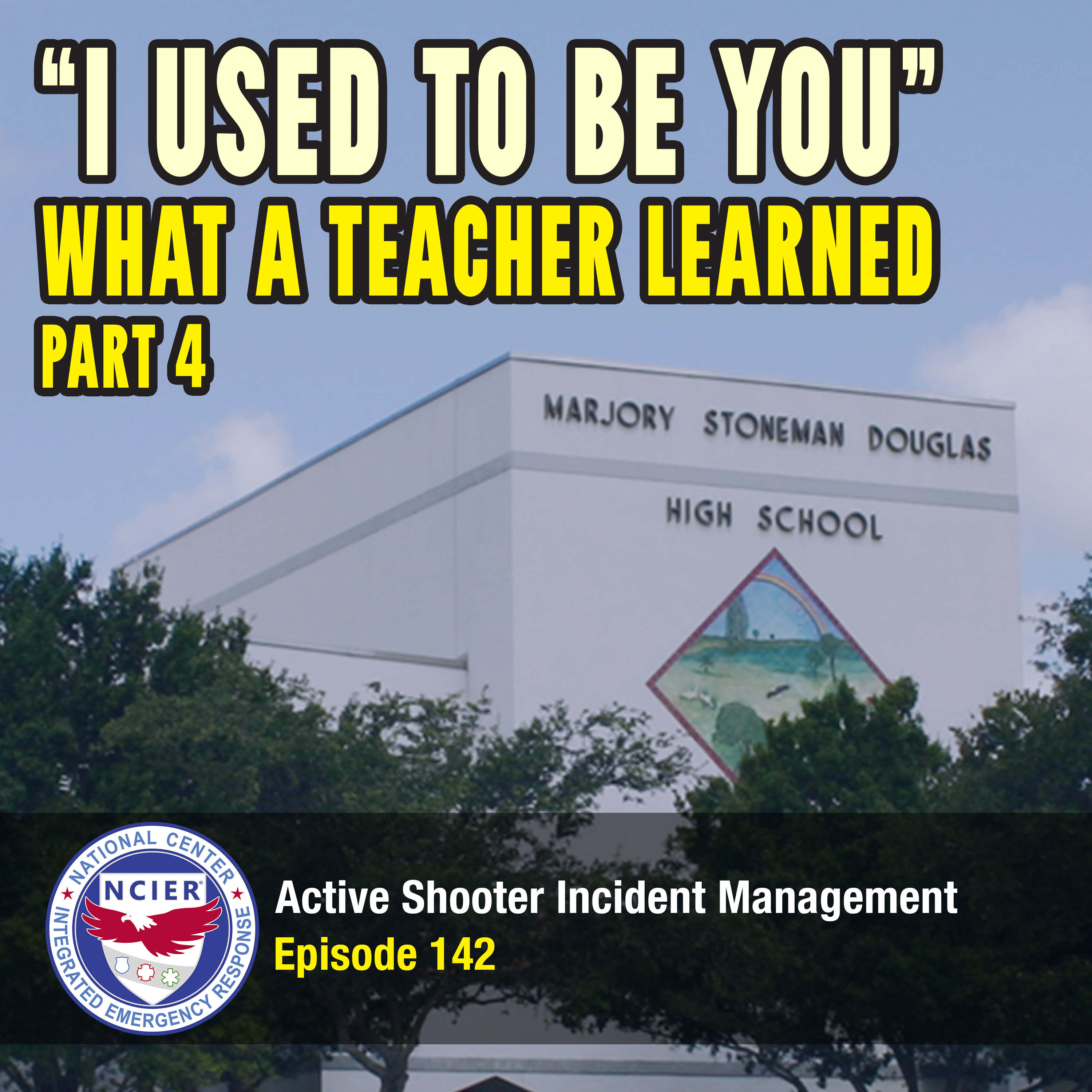
Ep 142: Part 4 - What a Teacher Learned from the Marjory Stoneman Douglas / Parkland School Shooting
Episode 142
Published Nov 5, 2026
Duration: 24:40
Episode Summary
A reunification plan gets tested the moment someone pulls up a map: how many ways in and out, where 3,000 students could wait, and where the buses are at dismissal. That’s why schools and public safety have to build it together. Kim Krawczyk, a teacher who survived the Marjory Stoneman Douglas shooting in Parkland, explains why she would rather have stayed behind a locked door than been evacuated while police were still searching for the shooter. She and Bill Godfrey discuss bus shortages and the timing of arrival and dismissal, along with getting an administrator into the command post and evacuating in organized zones with clear updates. Kim closes with messages for first responders and fellow educators. This is Part 4 of a four-part series. For school safety training, take the free one-hour SSAVEIM Foundations school safety course at https://ncier.org/ssaveim/foundations.
Episode Notes
What happens when a school’s reunification plan meets real traffic, a bus shortage, and a suspect who may still be on campus? Kim Krawczyk, a teacher who survived the Marjory Stoneman Douglas shooting in Parkland, explains why she would rather have stayed behind a locked door than be evacuated across a chaotic campus.
In the final part of the series, Kim and Bill Godfrey dig into why reunification so often goes poorly and what an organized, staged evacuation could look like instead. It’s a practical conversation for school administrators, teachers, school resource officers (SROs), and the police, fire, and EMS leaders who share responsibility for getting students safely back to their families.
In this episode:
🔹 Why reunification plans built on assumptions fall apart. Examples range from a backup site with only two ways in and out to incidents at arrival or dismissal, when buses are spread across multiple routes.
🔹 “Leave me there.” Kim reflects on why sheltering behind a locked door, with updates by text and students able to reach their parents, would have been safer than evacuating while police were still searching for the shooter.
🔹 How a school administrator in the command post, regular PA updates, and zone-by-zone evacuations can bring order. Kim also describes the code words her school began using after the shooting to authenticate holds.
Kim closes by asking first responders to be ready, and fellow educators to stop treating safety training as a joke, the way she once did.
💬 𝗗𝗜𝗦𝗖𝗨𝗦𝗦𝗜𝗢𝗡 𝗤𝗨𝗘𝗦𝗧𝗜𝗢𝗡: Has your school tested its reunification plan against a real map, real bus availability, and a real time of day?
🎧 𝗪𝗔𝗧𝗖𝗛 𝗧𝗛𝗘 𝗙𝗨𝗟𝗟 𝗦𝗘𝗥𝗜𝗘𝗦 𝗢𝗡 𝗬𝗢𝗨𝗧𝗨𝗕𝗘:
Part 1 – What prepared a teacher for the MSD shooting: https://youtu.be/qT7nqXZLQPI
Part 2 – School drills, warning signs, and behavioral threat assessment: https://youtu.be/fPID4vPjT5A
Part 3 – Locking classroom doors, evacuation, and shared responsibility: https://youtu.be/YFY1iCwmtmM
Part 4 – Reunification and why staying behind a locked door can be safer: https://youtu.be/iVlugcEPkD4
🎓 Take the free one-hour SSAVEIM Foundations school safety course: https://ncier.org/ssaveim/foundations
School Safety and Violent Event Incident Management
📌 𝗖𝗛𝗔𝗣𝗧𝗘𝗥𝗦
00:00 Introduction: Kim Krawczyk, MSD shooting survivor
00:39 Why reunification plans break down
01:49 A backup site that doesn’t hold up on the map
03:35 Arrival and dismissal timing and bus shortages
05:40 “Leave me there”: staying behind a locked door
07:35 What should happen once the dust settles
08:36 Getting a school administrator into the command post
11:41 Evacuating in zones with clear updates
15:41 “Nobody called a code”: communication and code words
17:55 Kim’s message to police, fire, and EMS
19:44 Kim’s message to fellow educators
22:46 Meet Archie
#SchoolSafety #Parkland #Reunification #SchoolEvacuation
View this episode on YouTube at: https://youtu.be/iVlugcEPkD4
Transcript
Karla Torres:Welcome back. I'm Karla Torres, and in the final part of our series with Kim Krawczyk, we are discussing reunification and why staying behind a locked door can be safer than rushing out. If you missed the earlier parts, the links are in the description.
Kim Krawczyk:
I'm the one behind that door. Could be anybody. Some of those cops had their kids on that campus. I need you to come in. I need you to do what you were trained to do, because I'm going to do what I was trained to do. We're going to save these kids, but we're going to have to do it together.
Karla Torres:
Now, let's get right back into it.
Bill Godfrey:
So let's talk a little bit about reunification. You mentioned the one in your experience didn't go very well. And to be honest, in every incident I've studied, reunification doesn't go very well. It's a lot of assumptions, with inadequate planning and inadequate preparedness in many instances. I'm not sure how we get that message through to school administrators and district personnel. Then let me say this. In my opinion, this is both sides' fault. Public safety's fault, because they don't think reunification has anything to do with them, and it's not their responsibility. And the schools make assumptions about how they're going to do it without having a conversation with public safety, and they live in this world that is based on everything but reality.
A perfect example: just last week, I was having a conversation with a school district. We were talking about a particular campus they had. Large campus, just under 3,000 kids. And I said, "Okay, what is your reunification plan?" They said, "Well, we're going to reunify on site." "Okay. What if you can't?" "Well, why wouldn't we be able to?" And I rattled off about a half a dozen reasons why they wouldn't be able to reunify on campus. And they go, "Well, then we'll go to this other school." Their reunification plan was to go to another high school that was five minutes away. And I said, "Okay," and we pulled up the map, the overhead of that school.
And I looked at it and I said, "How many kids are in this school?" And it was another large school, more than 2,000 kids. And I said, "All right..." And literally, there are two ways in and out of this campus. The entire campus, two ways in and out. There's one way that comes in from the front administration office, and then one way the kids would come in to park. That's it. I said, "So what's the plan? How do you empty this school so that you can bring the kids over from the other school? What does that look like?" The assembly areas, none of the assembly areas held more than six or seven hundred kids. "What does that look like?" "Well, you know, it's a good question."
And I start to see this look on the faces of the administrators. I don't know how we get both sides to realize this is their problem to figure out together.
Kim Krawczyk:
It has to be something that's together, and it has to be understood. So from what I understand, and I wasn't here at the time, West Orange had an incident during afternoon release, and they had a difficult time with everybody scrambling and then tracking where people were. But we had the same thing. Ours was at 2:21, right? And so you're talking about right at the end of the day. And here's the part that has to be taken into consideration that's unique to these situations: your buses are someplace else. You can talk about moving kids all you want, except in a world where we have two, sometimes three rounds of buses because we don't have enough drivers. We don't have enough buses running in the first place just to deal with our population when nothing's going on.
You have to make arrangements around moving these kids to some of these places when everything's going on. And so it would be nice to operate in a vacuum at 10:03 on a Thursday, when we can get all of our buses into one place and get these kids out. But the reality is... Santa Fe. Santa Fe was egress, breakfast. As the kids are migrating onto campus, all of this goes down.
Kids are still pulling into the parking lot, walking through, open everywhere. Buses are pulling in, people are coming, teachers are parking, right? You've got all of this going on. How do you operate around that? How do you prepare for something like that? There were agencies that couldn't get on campus because they couldn't get around the kids who were coming in. You think about all of those things. I told you I have a friend that's there. What happens? Her husband comes, gets the pickup truck as close as it can, and he literally runs on campus to get her, to take her to the hospital, because it's mayhem. And so, talking to your point, and I actually appreciate this, because this isn't something that I would have considered, but it makes total sense: leave us there.
Find a communication system. You have my phone number. Text message me. We have Remind and all these fancy apps now to get in touch with each other. But why am I being evacuated, literally marching across Holmberg, when I hear that kid's name, and the fact that they think he and an accomplice are in our auditorium? Why am I out of the room when you're still looking for that person on our school campus? No, no, no. Now, was he there? No. He had taken off and gone. Everybody knows the story. But at that very moment, we didn't know where he was. Nobody knew what was going on. And so you have all these kids racing around, and like I said, there's media, there's press, and people getting picked up, and there's just all this stuff going on.
Leave me there. I get that the parents want to see their kids. My kids were able to get in contact with their parents, right? We have the technology to do those things now. Leave me there. I would much rather be safe in a room, behind a locked door, than out running through a parking lot hoping that everybody's gone. Right? There wasn't an accomplice in our case. What if there was? So I like your point.
Once you have everything, the dust settled, even simple things like calming down your cops, lining up the buses. All of the triage is now off campus, right? Because that was a lot for my kids to see. That was a lot for anybody to see. Getting some of that press out of there: "Sorry, guys, we're setting up a barrier. No one's allowed in here."
And then we get everybody on, everybody to the reunification, eyes on everybody, hand them off to their families. Those are the things. But I would have much more preferred to be in a situation where I'm behind a locked door, as opposed to watching my kids run for their lives because they said he's coming this way.
Bill Godfrey:
One of the many lessons that we've learned was the importance of getting one of the administrators from the school out and into the command post as quickly as possible. So much so that we've actually changed procedures, changed what we're teaching, to advocate for that. But it's a twofold purpose. One, obvious to anyone who thinks about it, would be: okay, yeah, I can see the principal or the senior administrator, or somebody senior level, needs to be in the command post to answer questions. Typical cops, they know the school's there. They don't know how many kids are there, that kind of thing. But the other piece of that is direct communication with the staff that remains in the front office.
Because while the first 15, 20, 30 minutes of this is going to be pretty busy dealing with the threat, which 90% of the time is 10 minutes or less, our goal is to get everybody that's injured off the scene in 20 minutes or less. Now, that doesn't always happen, but that's the goal. But around the 30-minute mark, as you put it, the dust should be settling a bit. And that's a great point at which the person that's locked down in the front office gets a radio call from the administrator in the command post that says, "I want you to put this message out over the PA." And you give everybody a quick update.
And then you continue at fixed intervals to provide updates over the PA, and kind of take a breath. You mentioned getting the officers to calm down. I think you're spot on. I also think that everybody that was removed from the immediate violence but is still scared to death also needs a chance to take a breath and calm down. And so we're working through this.
It's new, and anything new is controversial. We have a joke in the fire service: the fire service is 200 years of tradition unimpeded by progress. And we mean that. And law enforcement's not far behind us. They're a little bit quicker to adapt, but not by much. So we're working on it. Does that kind of thinking make sense to you? You were in this horrible situation. You're now an administrator, one of those people that's in and out of the front office, who might be tapped to come into the command post. Does that kind of connection, "Okay, the first 20 minutes are going to be chaotic, but at 30 minutes, we're in for a very long day here," does this make sense to you?
Kim Krawczyk:
Absolutely. Absolutely, because then you can roll out. So, like I said, minus the freshman building, Stoneman Douglas is all catwalks, and they're little cluster buildings kind of put together, kind of like how we have some of the ones here.
Bill Godfrey:
When you say catwalks, you mean just elevated hallways that are?
Kim Krawczyk:
Yeah. The doors come out to the outside. We don't have a lot of interior hallways. So it's cement, like a circle or a horseshoe, and the classrooms just empty out onto that, into the exterior. So it's not like an interior hallway, where you walk into a traditional brick-and-mortar school that's just like a big giant box, and the kids walk through the hallways and take the stairs and go to their classrooms. You're coming out in all different places. But then you can operate in sections, and you can communicate to those teachers. Like, "Zone one. Zone one: prepare your kids for evacuation. Estimated wait time, three to seven minutes." If we can put that on a billboard for our emergency rooms, we can go ahead and tell our people, "We're coming for you. You just need to be a little bit patient," right?
And then prepare your kids. Things like, "Hey, I need to grab my cell phone," or, "I do need to take some of my personal things." Or even if you want me to leave things behind, the kids can communicate that to their parents, or whatever's going to happen. And that teacher has some training and can... I'm not talking about the rooms that were fired into. I'm talking about in my situation, or even a situation where you're on the outskirts or in one of the other buildings. And you can prepare your kids. And those people now have, like you said, looked at a pathway. What's the quickest way to get these kids out in an organized fashion? And what bus are they going on?
"Oh, you're going on bus 3294. Okay. So classrooms A, B, and C are going on 3294. These are the teachers that are in charge. These are the roster lists that we have." And those people in the office, to your credit, as you're giving commands, they can say, "Okay, I'm getting this from police. We're evacuating these rooms. Please make sure that these teachers understand." Because we all have emergency folders. Everybody, anywhere that I've worked. They have some type of a thing that's like, "Oh, these are the kids that are with me right now. I know who's absent and who's not. Let's go." And it becomes a much more organized way. Yeah, I understand some people will complain, like, "Oh, I had to wait a really long time."
But I will also equally tell you that because of the chaos on the campus and the way that it was organized, I had friends at Stoneman Douglas that did not leave that campus until 8:00, 8:30 at night. So it's going to be a long day, and there's a lot going on. I'd much rather see it done in an organized fashion where everybody is safe than, like I said, see the absolute chaos that ensued once they released us into the wild. And I do think somebody who knows the school can say, "Oh, hey, these are the two stairwells you can take down. These classrooms have the highest number of kids, so they should probably come out first," because they're probably going to have to come out in waves. Or maybe we can do a larger section, upstairs, downstairs, that type of thing.
But somebody who knows the school can talk to the logistics and get the first responders to understand. They can think about how they want to handle it, and keep in communication with the teachers, letting them know. Because we didn't have any information. Like I said, the story is nobody called a code. Nobody called a code over the speakers. That information wasn't available to us or anybody else that wasn't in our building. So if you hear the fire alarm, but you didn't hear the gunfire, you're evacuating your classes. And again, that's more chaos and more mayhem. And if you have some type of a communication system, you know, "Teacher alert: 911 has been called at this time. We are on a hold."
"Identified. We're no longer on a hold. You can go about your business." Or, "We are currently on lockdown. Target identified," or whatever you want to call it. "A situation has been identified. Please lock down at this time. Get into your safe corners at this time." These are the things. And then one of the things I liked that we did at Stoneman Douglas, but see, it was after the fact, right? It was like, "Oh, okay, now that this all happened..." When we would do drills or any kind of a thing, it had a secret code word. The code word came out to the teachers.
We would get it at the beginning of the month, or after we had an incident, right? We had incidents that happened around the campus, and so we would have to go on a hold. And so in order to authenticate that hold, we would get a password, so we knew that it was real. And then, of course, they would give us a new password after that. Like, "Okay, that one's gone because we've already used it. So the next one is..." who knows, "Daisy Mary."
And I liked that, because it's very organized. You know, fire alarms go off all the time. Any school that has a culinary program worth their salt knows that you're leaving at least once a week, right?
Bill Godfrey:
So Kim, as we wrap up, I'm going to ask you two questions that are related, but one about public safety, one about schools. If you had words to share with a police officer, firefighter, paramedic standing in front of you, what would you tell them?
Kim Krawczyk:
I do know the answer to this. I'm trying to... I get that this will be the most terrifying, overwhelming situation possibly in your lifetime, in your career. I'm going to hope it never happens, but I'm also going to hope at the same time that anything else that's happened to you doesn't even come close to this, right?
But you're coming for me and my kids. Be ready, as much as you can. Don't choke. There are videos out there of those guys struggling with their vests for two minutes, and they get back in the car and drive. I'm the one behind that door. Me. Could be anybody, right? Some of those cops had their kids on that campus. I need you to come in. I need you to do what you were trained to do, because I'm going to do what I was trained to do. We're going to help. We're going to save these kids, but we're going to have to do it together.
Bill Godfrey:
And what about your peers in schools?
Kim Krawczyk:
Stop acting like this is a joke. This is coming from me. I thought it was the biggest joke ever, right? This is coming from me. School safety can no longer be something that's taken lightly. I can remember what I was doing when Columbine happened, just because it was so incredibly outlandish. I can remember exactly what I was doing at the time.
Can I remember what I was doing when I heard about Sandy Hook? I can't. Can I remember what I was doing when I heard about... I mean, I can remember seeing Santa Fe. Can I remember what I was doing with Uvalde? No. Can I remember what I was doing when I heard about Apalachee? No. Why? Because now it happens so often. It's almost becoming normalized to hear about something like this on the news. And you think to yourself, "Well, I mean, as long as it's under 10, I guess we really got away this time." That shouldn't be where we're headed. We shouldn't normalize this to the point where there's a breakpoint where our losses are acceptable, because that's somebody's kid.
Stop taking this as a joke. Stop thinking it's not going to happen to you. I'm not saying it's going to happen to you, but you have to put it in your mind somewhere: it's always a possibility. Again, insurance. Nobody makes a plan to get in a car accident. Nobody makes a plan to get a cancer diagnosis. Nobody makes a plan to have something tragic happen in their life. That doesn't mean it doesn't happen.
Be ready. Take it seriously. As much as you focus on your content and you focus on that kid's learning, remember that the kid also has to be safe. Because, like I said, if they're not safe, they're not learning. Doesn't matter what you're doing over here. If those kids don't feel safe, that's not happening.
Bill Godfrey:
Thank you so much. Let's end on a positive note. I think everybody would be interested to know, if they've been watching, every once in a while, you and I both have had our eyes dart off just a little bit. Would you like to introduce Archie to everybody?
Kim Krawczyk:
Sure. Karla, is he visible, or do we need to adjust a camera? How you doing? This is Archimedes Krawczyk. Steadfast Archimedes Krawczyk. The kids call him Archie. And he, hi, yes, he helps his mom stay calm, cool, and collected when she's on a school campus, so I can keep thinking about the kids being okay. He definitely keeps my oars in the water, right? He makes sure that I'm safe and sound wherever I go.
Bill Godfrey:
He's a beautiful dog.
Kim Krawczyk:
Thank you. He was a gift. Actually, Coral Springs Police Department helped find him for me. God bless them. Yeah.
Bill Godfrey:
That's awesome. Kim, thank you so much for coming in and giving us your time. It's been absolutely amazing. I hope the opportunity presents itself for us to get back together and do this again sometime.
Kim Krawczyk:
Yes. Thank you.
Bill Godfrey:
Thank you.
Karla Torres:
That wraps up our series with Kim Krawczyk. Thank you for being with us for every part of this conversation. You can comment below or email us at info@c3pathways.com with topic suggestions or questions. I am Karla Torres, your video producer. Until next time, stay safe.