
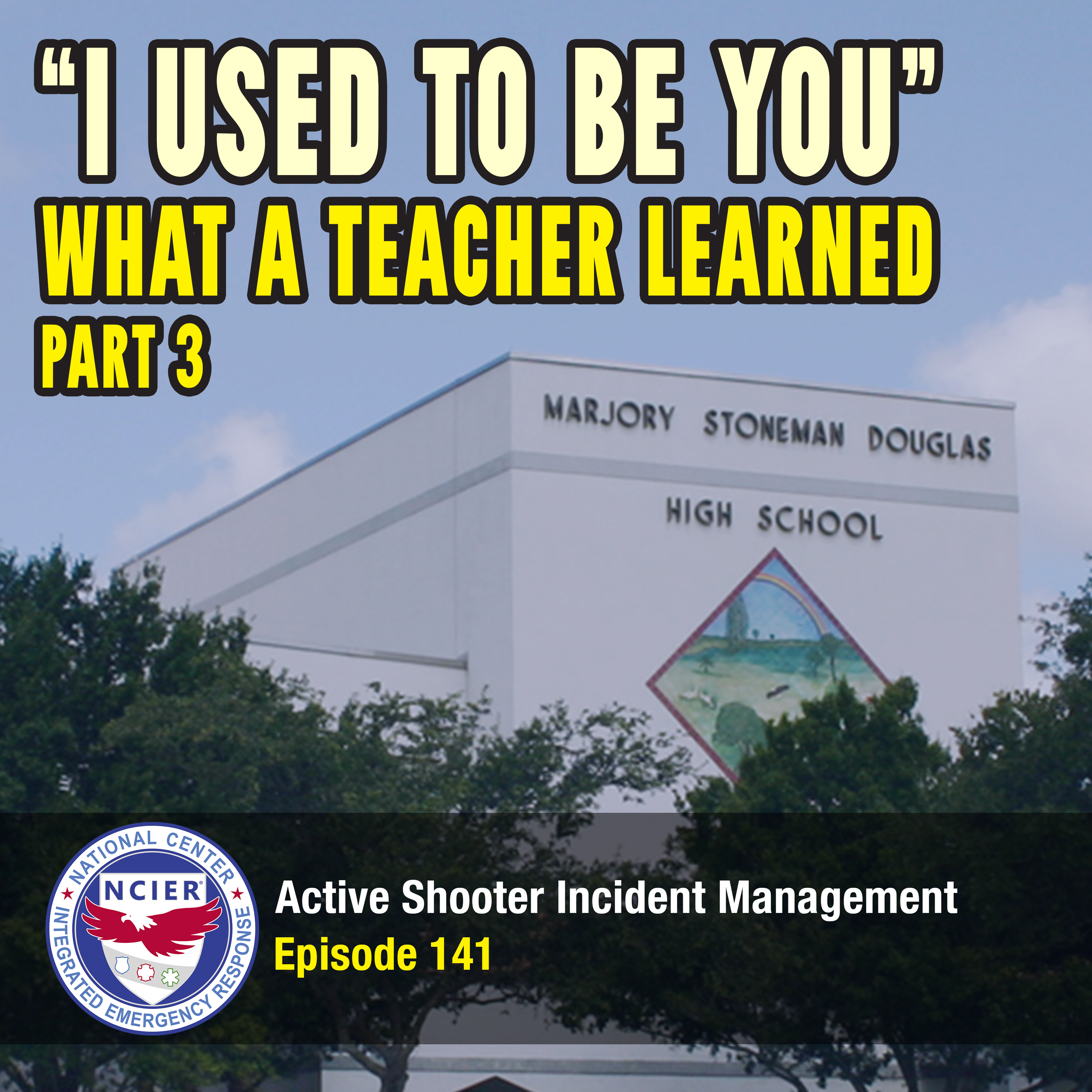
Ep 141: Part 3 - What a Teacher Learned from the Marjory Stoneman Douglas / Parkland School Shooting
Episode 141
Published Nov 3, 2026
Duration: 25:03
Episode Summary
Locked, dark, and silent classrooms left a gunman trying doors and asking where all the kids went. Kim Krawczyk, a teacher who survived the Marjory Stoneman Douglas shooting in Parkland, explains why she tells teachers that leaving a door unlocked is a decision about their students’ safety. She also recounts how the evacuation fell apart, with students scattering, media arriving ahead of families, and staff left without support. She and Bill Godfrey discuss why rushing everyone out can add risk and why emergency kits and master keys need real audits. This is Part 3 of a four-part series. For school safety training, take the free one-hour SSAVEIM Foundations school safety course at https://ncier.org/ssaveim/foundations.
Episode Notes
What happens when a gunman tries a classroom door and it won’t open? Kim Krawczyk, a teacher who survived the Marjory Stoneman Douglas shooting in Parkland, shares why locked doors spared the second floor of her building, and why she calls the evacuation afterward one of the day’s biggest failures.
In Part 3, Kim and Bill Godfrey look at the everyday habits and plans that decide how a school shooting unfolds: whether teachers lock their doors, whether emergency kits actually hold what everyone assumes they do, and whether anyone is accounting for students once they leave the building. It’s a direct conversation for teachers, school administrators, school resource officers (SROs), and the police, fire, and EMS leaders who plan alongside them.
In this episode:
🔹 In everyday school life, when a student is struggling, who steps in: the family or the school? Kim and Bill discuss outreach programs and why families and schools have to work together for kids.
🔹 “Where did all the kids go?” Kim describes the shooter trying doors on the second floor and moving on when he couldn’t get in. She also shares the blunt message she now gives teachers at beginning-of-year safety meetings about leaving doors unlocked.
🔹 What happened after the evacuation: students scattered across the street, only one of Kim’s students got on the bus to reunification, news crews got closer than families, and staff were in shock with no one checking on them.
🔹 Why rushing everyone out can add risk while a suspect is still at large, and why missing master keys and emergency kits need real audits.
💬 𝗗𝗜𝗦𝗖𝗨𝗦𝗦𝗜𝗢𝗡 𝗤𝗨𝗘𝗦𝗧𝗜𝗢𝗡: Does your school check that classroom doors are actually locked during drills? What would it take to make that a habit on your campus?
🎧 𝗪𝗔𝗧𝗖𝗛 𝗧𝗛𝗘 𝗙𝗨𝗟𝗟 𝗦𝗘𝗥𝗜𝗘𝗦 𝗢𝗡 𝗬𝗢𝗨𝗧𝗨𝗕𝗘:
Part 1 – What prepared a teacher for the MSD shooting: https://youtu.be/qT7nqXZLQPI
Part 2 – School drills, warning signs, and behavioral threat assessment: https://youtu.be/fPID4vPjT5A
Part 3 – Locking classroom doors, evacuation, and shared responsibility: https://youtu.be/YFY1iCwmtmM
Part 4 – Reunification and why staying behind a locked door can be safer: Coming Thursday 11/5
🎓 Take the free one-hour SSAVEIM Foundations school safety course: https://ncier.org/ssaveim/foundations
📌 𝗖𝗛𝗔𝗣𝗧𝗘𝗥𝗦
00:00 Introduction: Kim Krawczyk, MSD shooting survivor
00:37 Parents, schools, and shared responsibility
06:03 Alert fatigue: when every lockdown feels like a drill
09:03 “Where did all the kids go?”: why locked doors matter
11:26 What went wrong during the evacuation
14:21 Students scatter instead of reaching reunification
17:01 Trauma, missing people, and media on scene
19:52 Why rushing everyone out can be the wrong move
22:10 Missing master keys and emergency kit audits
#SchoolSafety #Parkland #SchoolLockdown #TeacherSafety
View this episode on YouTube at: https://youtu.be/YFY1iCwmtmM
Transcript
Karla Torres:Welcome back. I'm Karla Torres, and in part three with Kim Krawczyk, we are discussing why every teacher should lock their classroom doors, what happens after an evacuation, and why schools and families have to share responsibility for keeping kids safe. If you missed the earlier parts, the links are in the description.
Kim Krawczyk:
Those kids are our responsibility. Those kids are compelled to come to our campuses. We tell those parents in those communities: bring your kids to us. It's our job to get them home safe.
Karla Torres:
Now, let's get right back into it.
Bill Godfrey:
We're in a different time of society now, where kids are growing up very differently than how I grew up, and I'm guessing the same for you. And there's this really blurred... It's not even a line anymore. It's like a 300-foot-deep no-man's zone of who's responsible for parenting the child: the parent or the school. You mentioned the village. And it's a very murky gray area in between, with both sides having responsibility but not clear agreement on where that sits and how it's supposed to go.
How do we navigate that time where you read these headlines about parents that were kept in the dark, uninformed? The school knew all of these things, the struggles of the child, but didn't share any of them with the parents. And then the reverse of that: the school tries to get the parents very engaged and involved, telling them about the problems that their child is struggling with, and the parents don't want to hear it, don't want to acknowledge it, don't want to engage. They push it back and blame the school.
I'm not going to ask you the question of how we solve that, but how can we try to make that a little bit better, do you think?
Kim Krawczyk:
When I was growing up, we had... I think it was called the PET program, right? Then it was parent education training, right, where they would bring them in. I think my mom... My grandmother would come, and she would go to some of these things, and it was part of being in the community. It was run in conjunction with the parent-teacher organizations, and then the schools, and the districts, and all of that kind of stuff. But of course, one of the things that everyone will say is, "Oh, well, she had time to go to those things," which is absolutely true.
But I've worked in schools where we've offset the schedules of our school psychologist and our school... I don't know why I can't think of it right now. Isn't this terrible? The social worker. Hi, Kim, how you doing? So the school psychologist, the school social worker, and some of the administration have offset schedules where they stay later in the evening for some of these parents, so that they can come into some of these outreach programs. I know sometimes they need to be incentivized. I get it. It takes money. It takes time. But again, look what we're building. We're building our future.
You can't look at school like doggy daycare, right? "I got my kid all of his shots, and now I drop them off for the day, and they get to have all these experiences. And when I pick them up, they're all excited, and then we just go home and live our best life." We have to understand that there's some type of coming together and working together within these communities, for all the stakeholders. If you run a business and you want your business to be in the community, you want to work with the people. Let's say you bake cookies. Bring your cookies over to my meeting, put little labels on them, and we'll give you five minutes to talk about what you see in the community or what you're experiencing, right?
Do you have any concerns? "Oh, I see a lot of traffic with kids that are unsupervised at the local McDonald's, and I worry that I have to shut my doors during certain times for egress." How does that work? What do you guys think we can do about that? And maybe the manager of McDonald's says, "Yeah, here's what we do for that solution." Or maybe the school systems... and some of this is pie in the sky, hoping that we get some after-school programs put together. But again, if we're creating that situation, if we're coming to the agreement that, as the project... I hate to even use the word "social," because I don't want anybody to expand on that. But if we have this community that we're trying to build, then we have to work together as community members to understand that we're helping these kids reach where they want to be, or where they should be, as citizens that can function well in our society.
Not just units that we train and graduate and then set out into the world.
Bill Godfrey:
I'm going to tangent back to talking a little bit about campus preparedness. We talked earlier about the drills, and you mentioned it's conditioning, it's apathy, there are challenges. In fact, in Uvalde, they had one of these electronic alerting systems that was alerted. Some people didn't get the alert. Some people ignored the alert. In the aftermath, they discovered in the immediate months preceding, I think it was four months, I don't remember the exact number, they had had 28 lockdown alerts. Legitimate, not drills. 28 lockdown alerts in the months prior. So it was averaging one a week. Uvalde sits on the border, and there was concern about legitimate risk from vehicles carrying large numbers of people trying to get into the country, coming across and then bailing out and running.
Because you never knew what you got. They would call in a bailout, and they were activating lockdowns for bailouts. In reality, the proper action probably would have been Secure, not lockout. Secure the exterior of the campus and then carry on business inside, because the problem is outside. There was a pretty strong indication that those many alerts prior created just an apathy, almost like it was another drill. There were doors that had broken locks. Doors literally supposed to stay locked that couldn't be locked. There was apathy. And I'm going to tangent off Uvalde and go a little bit wider. There is apathy among teachers who don't want to lock their doors, who don't make the muscle memory of locking their door every time there's a lockdown drill.
And you see some schools where they take that very seriously, and the principal moves around and checks doors and checks that they're locked. Those are the exception, not the rule. How do we get through to people who are there in the school, from leadership to the staff, to custodial services, to the cafeteria workers, to the teachers?
We don't want something to happen. We want it to not happen. But we have to take these things seriously. How do we make that better?
Kim Krawczyk:
So one of the things that I talk about, especially when people ask me to go through it, there's an animation for us, right? There's an animation of the second floor. And there's actually a point where the little character is standing kind of still, and you can see the rotation. And three different teachers, in their depositions, separately said that one of the things he said out loud was, "Where did all the kids go?" Because as he's trying doors, he can't get into the classrooms. They're dark. He doesn't hear anything. He doesn't see anything. And so what does he do? He moves along. And one of the things I'm always not only grateful for but point out is that the second floor was spared because of the action that they took.
When I talk to some of the teachers, I've been going to schools and doing the beginning-of-the-year safety meeting. When I go and talk to them, I will literally say, and I'm not going to dance around this. This is not something that I'm going to be kind about. "You're not locking your door? You have already made the decision that your convenience..." Let's talk about having a revolving door on a classroom. That's not right. "...your convenience is worth more than any one of those kids in your classroom, and possibly all of them." That's the conscious decision that you're making when you don't lock that door, or you put a basket in there, whether you want to admit it or not.
You're making that decision. You are the grown-up in the room. You are the adult in the situation. You are in command. You call that your classroom. Those kids rotate in and out of there, but it's your room. If you're going to leave that door unlocked, then you decided. It's not even your life. It's just a matter of convenience. Just not having to go over to the door and pop it open, or designating a door opener. You've already decided that your little inconvenience is worth way more than any of the people in your classroom.
Bill Godfrey:
That's pretty powerful. The day of the attack, what are the things that stood out to you from the public safety response? Looking forward, what words of wisdom would you give to police officers, firefighters, paramedics, leaders of these organizations, so that nobody has to live that again? What would you say were those things that we can improve upon beyond the event?
Kim Krawczyk:
The egress, the evacuations. Awful. But I don't think there's a single thing that you can do about it. Do you know what I'm saying? In my mind, in Kim's world, I did not expect to come out of my room and see anybody, right? Now, in reality, it occurs to me that you leave a crime scene looking the way it does because of the way the forensics work, and evidence, and whatnot.
But during the evacuation, we get down the stairs, and when we come out, they literally lose control of us. And it's mayhem. And it's mayhem on mayhem. They tell you you can't bring anything with you. I took my cell phone. I had it on my person. But I left without keys, my eyeglasses. I didn't have my wallet with me. Everything gets left behind because, of course, the most important thing is getting the human out, right? But we also have to remember things like: How do we contact people? How do we find these families? How do we track these kids? How do we know who's in and who's out? One of the worst stories that comes out of part of the aftermath is Lori sitting on a curbside on 360, saying, "My kid's still in that building. I know where she is."
And I think that is the beginning of her reality, the understanding of what her situation is going to be once she gets to the hotel. But my kids scattered like birds. They tell you, "This is how we're going to do it, in an organized fashion: class by class, floor by floor, whatever that ends up being. We're going to load you onto a bus, we're taking you to reunification, we're going to process you, we're going to put eyes on everybody, and then we're going to release you to either parents, or guardians, or significant others," however that's going to work, but everybody that's coming out of that situation, right? At the time that we're out, we still have police panicking.
They're looking for him in the auditorium. They're doing triage on the side, so some of the kids are witnessing that as they're scattering through. Out of all of my kids that were with me, only one gets on the bus to go to the reunification. Only one, to the reunification? Yeah. And so I don't necessarily know that any of that was addressed afterward. I did meet with Broward Emergency Services, because they were interviewing everybody on what happened.
The evidence is lost, because my kids have blood on their shoes, and they're throwing them into the bushes across Holmberg and taking off. We've got kids literally lying on the side of the road having panic attacks, so stricken from what they just went through, or the things that they saw, or they walked over their friend, right? You've got the ambulances trying to do triage on the people that are wounded, but there are also other wounds or incidents taking place: shock. You've got teachers going into shock. You've got people going into shock. We had this one poor woman walking around saying, "I can't find my car. I can't find my car." You're not getting your car. You're not getting anything today.
We need to get you to safety. Her being so out of herself, and no one laying eyes on her before they either released her to her family or set up appropriate services, whatever those things were going to be. And one of the people said to me, "Well, it's a lot." It is a lot. And if you didn't want to have to do a lot, then you should have made sure the gate was shut.
It's a lot. But now you've got 3,150 kids and approximately 200 teachers and staff. What happens to the little custodian who locks herself into the broom closet because she can hear everything going on? She just got on shift, and now it takes until 7:30, 8:30 for somebody to let her out. Did anybody process her for the trauma that she might have? Or do they make the assumption? Was she reunified? Did somebody call her family? That person counts too. It was just so much chaos, and so little control. Moreover, reporting news stations were able to get closer to us than our families and rescue services. Think about that. I can get a news station in closer to the school than the pickup point for the families, for these children that are being released, where I had to walk to get picked up by my son.
And so, no. We're not protected. We don't have any privacy in the situation. We're under these cameras and lights. All of these people are coming in. Different agencies are coming in from all different places. Again, like I said, there are kids literally lying in the grass heaving because of what they just saw. They're 14. They're not emotionally prepared for this. I don't care how many video games they play. You can blame anything you want on video games to point out how desensitized they are. Those kids were not desensitized. They were going into shock. Some of them lost their friends. Kids running around saying, "This one is gone. This one was shot. This one was killed."
Right? And so these kids are learning in real time all of the things that are happening. Crazy Snapchat videos came out with everything. They're sharing all these things, and we had zero control over any of that. That, to me, is one of the biggest failures. I don't want to say horrific. The shooting was horrific. But as far as failing...
I go to these meetings all the time. "Oh, yes, the reunification plan is in place." Is it? Are you sure you know what that looks like in real life? Because everybody can say, especially when there are multiple agencies involved, everybody can say they know what they're doing. Do they know what they're doing?
Bill Godfrey:
I'm going to come back to reunification in a minute. There's a lot to talk about there. One of the learning points in public safety, and it's been a challenge, has been this sense of urgency to get everybody out in a rush. On the one hand, it's understandable. It's human nature. Something bad's happening there, we want to get away from that. But it belies a misunderstanding of where the danger actually lies, in a lot of the things you're saying. And in your case, the suspect was at large. He was not in custody. Correct. He was at large. And so the state-of-the-art training and thinking on this is trying to keep everybody in the classrooms, where they're behind a locked door.
Keep them there. Deal with the threat first, as quickly as possible. Deal with the injured as quickly as possible and remove them from the scene. Then take a beat and say, "Okay, how big is our crime scene? What are the numbers? What's the reunification plan? How do we move the kids that are in unaffected areas? How are we going to move those that are in buildings that are affected? Can we get those rooms moved without passing the traumatizing crime scenes, and things like that?"
It's a long road, I'll be honest with you, Kim. It's a long road. And as you might imagine, there are a lot of opinions. I know that would be shocking to you. We've got plenty of room for improvement on the public safety side, as much as I think the schools have room for improvement in really taking...
Kim Krawczyk:
For sure. Yeah. There's a responsibility on our behalf. Perfect. And to your point, the master keys were missing. So some of the plate glass in the doors, the lites, had to be shot out. Now, think about it. You're not on my part of the campus, but you know that there's a shooting. You're still subject to gunfire because they can't find the keys to your room.
We've all been told a thousand times: there's a safety kit in the front of the school. There's an emergency kit in the front of the school that's equipped with everything that the first responders are going to need. It has all of our keys, all of our rosters, all the teacher contact information, all of the emergency contact information, Stop the Bleed kits. Are we sure?
Are we sure? What do the audits look like for that? Because we can't keep just telling each other that everything's going to be okay, because there's a certain possibility that one day everything's not okay. I would have never expected to be in this situation in my life. But here we are. We all have car insurance, right? Do I leave the house every single day thinking about how I'm going to get in an accident? No. Do I have it anyway? Yes. Because you never know when something's going to go awry, because we're dealing with humans and human factors, and things happen.
It's the same thing. It's taking responsibility for being prepared, with the understanding that there are things in the universe that can happen to us, even when we least expect it. Those kids are our responsibility. Again, I've talked about this a million times. Those kids are compelled to come to our campuses. We tell those parents in those communities: bring your kids to us. It's our job to get them home safe.
Karla Torres:
We have a lot more ground to cover, so be sure to stick around as we continue our series with Kim Krawczyk. Be sure to like, subscribe, and turn on notifications so you're the first to know the moment it drops. Comment below, or email us at info@c3pathways.com for topic suggestions or questions. I'm Karla Torres, your producer. And until next time, stay safe.