
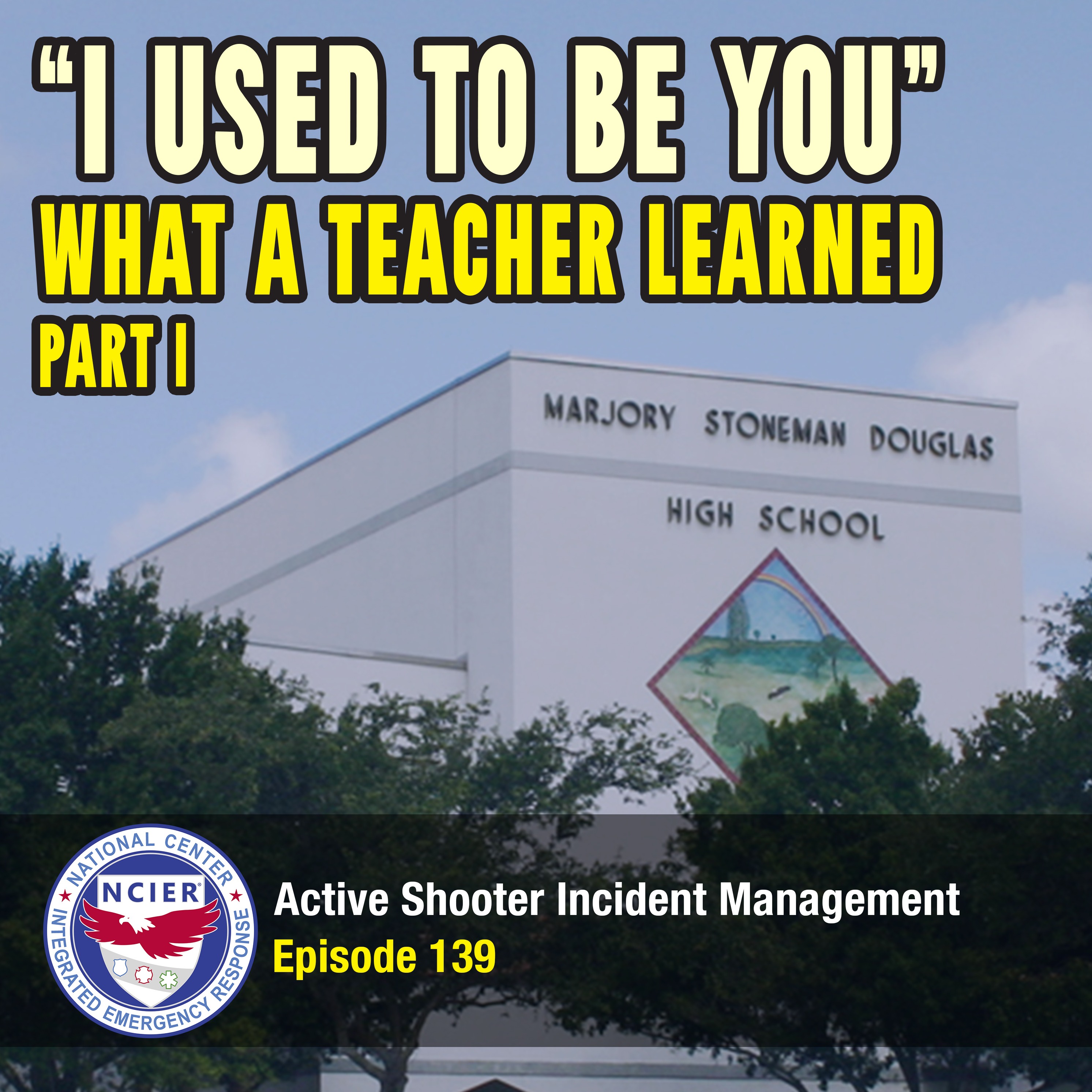
Ep 139: Part 1 - What a Teacher Learned from the Marjory Stoneman Douglas / Parkland School Shooting
Episode 139
Published Oct 27, 2026
Duration: 20:49
Episode Summary
She used to sit in the back row of school safety trainings with her hood up. Then came February 14, 2018. Kim Krawczyk, a math teacher who survived the Marjory Stoneman Douglas shooting in Parkland, explains how a police simulation she once considered “hokey” helped her anticipate every stage of the real event. She and host Bill Godfrey discuss why auditorium briefings fall short, how repeated drills condition students instead of training them, and the small classroom details she wishes someone had walked her through. This is Part 1 of a four-part series. For school safety training, take the free one-hour SSAVEIM Foundations school safety course at https://ncier.org/ssaveim/foundations.
Episode Notes
What actually prepares a teacher to protect a classroom during a school shooting? Kim Krawczyk was teaching math at Marjory Stoneman Douglas High School in Parkland, Florida, on February 14, 2018, and she credits the training she once dismissed as “hokey” with helping her stay calm and know what came next.
For school administrators, teachers, school resource officers, law enforcement trainers, and anyone who builds school safety programs, this conversation offers a teacher’s view from behind the locked door. Kim challenges the common approach of auditorium-style presentations and explains why classroom-specific preparation, realistic simulation, and the difference between training and conditioning can shape how people respond under gunfire.
In this episode:
🔹 Why one-size-fits-all safety briefings miss teachers. A gym, science lab, agriculture program, and math classroom each face different risks. Kim shares small details no training ever covered for her, like keeping student cell phones in the safe area and arranging the teacher’s desk to create a safe zone, and why walking teachers through their own rooms would make preparation feel real.
🔹 Conditioning vs. training. Kim describes students lining up at the door as if it were a fire drill instead of getting behind a closed door and explains why repeated monthly lockdown drills can leave students numb or dismissive.
🔹 The simulation that prepared her. Before the shooting, Coral Springs Police ran an exercise in a replica of the Marjory Stoneman Douglas (MSD) freshman building. Kim had experienced gunfire, fire alarms, cries for help, and door checks before the real event, so she knew what came next at every stage.
💬 DISCUSSION QUESTION: How does your school or agency make safety training feel real for the people in each individual classroom? Share your experience in the comments.
🎧WATCH THE FULL SERIES ON YOUTUBE
Part 1 - What prepared a teacher for the Parkland Shooting - https://youtu.be/qT7nqXZLQPI
Part 2 – School drills, warning signs, and behavioral threat assessment: Coming Thursday 10/29
Part 3 – Locking classroom doors, evacuation, and shared responsibility: Coming soon
Part 4 – Reunification and why staying behind a locked door can be safer: Coming soon
🎓 Take the free one-hour SSAVEIM Foundations school safety course: https://ncier.org/ssaveim/foundations
📌 CHAPTERS
00:00 – Introduction: Kim Krawczyk, MSD shooting survivor
00:22 – “I used to be you”: Kim’s view of safety training before Parkland
03:01 – Why auditorium trainings don’t reach teachers
04:26 – Cell phones, safe corners, and classroom configuration
06:59 – Text-to-911 and helping responders understand the scene
09:08 – Unique campus challenges: cafeterias, gyms, fields, and labs
10:58 – Conditioning vs. training: students lining up at the door
13:24 – “Okay, we’ve done the lockdown, now what?”
16:06 – The Coral Springs PD simulation that prepared Kim
#SchoolSafety #Parkland #ActiveShooterTraining #TeacherSafety #PublicSafety
Transcript
Kim Krawczyk:School safety can no longer be something that's taken lightly. I thought it was the biggest joke ever, right? This is coming from me.
Bill Godfrey:
We have a very special guest for you on the podcast today, Kim Krawczyk, a teacher that is a survivor of the Marjory Stoneman Douglas shooting in Broward County. Kim, welcome.
Kim Krawczyk:
Thank you so much for having me.
Bill Godfrey:
So I thought an interesting place to start might be what it was like for you as a teacher before all of this happened, and you were told to follow various procedures, to learn about this thing, to complete this mandatory online training, show up for some sort of safety meeting. What effect did that... Tell me about that experience, before this all happened.
Kim Krawczyk:
So before all of this happens, you know, I'm teaching math, a tested subject, and so all of my time is precious and, you know, I want to guard that or protect that as much as I possibly can, right? So when I get invited to these meetings, I think this is just a ridiculous exercise in futility. What am I doing here? I could be making copies, I could be doing curriculum, I could be doing all these things, getting myself ready for these kids, right? I could be grading for some of the ones that are during the school year, right? And so it never seemed like a good use of my time. It always just felt like something that was out in the universe that was never gonna affect me. So what am I doing? Right?
And so I would show up early to sit in that last row, pull a hood up on my hoodie, pull my strings, right? So absolutely not. Hold my arms. Listen to you. Find something to do on my phone. Bring my laptop, right? Infamous, put your laptop in a bag, bring it in on the side and then. Right? I'm sure they're looking out to all the little glows of the computer screens on people's faces, thinking to myself, you know, this is just, it's moot. It makes no sense to go through these things. This is not something that happens. It's not something that's gonna happen in my community, certainly, right? Until it did. And now looking back, you know, when I talk to some of these teachers, I tell them, you know, "Well stop, I used to be you. "If you hate being here, if you don't want to come to this training, if you think this is ridiculous because it's never going to happen to you, I get it. I was you. I was you." But one of the reasons that I keep going and I speak out is because I really need every one of these teachers to never become me. I don't want them to join my community ever. That's something that I keep working towards to make sure that these schools, they stay safe, and that teachers are prepared as much as they can be, right? Like, you can only prepare so much.
Bill Godfrey:
Is there something that jumps out at you that you think that the schools or public safety can do to make those experiences better for teachers that feel that way, that they don't see how it connects with their job, they don't think it's worth their time? Is there something we're doing wrong, something we can do better on that front?
Kim Krawczyk:
Actually, I do. I think bringing all of us into an auditorium and not actually coming into our hallways and talking, or into our classrooms or looking at some of our configurations or speaking with the teacher about some of their concerns, right? If I'm a teacher in the gym, I have a much different experience than the teacher who's in agriculture, than the teacher who's up in a math classroom, than a teacher who's over in a science lab. Some of those science labs, because they have to have certain evacuations and they've got the catacombs out back behind them, they have gas jets, they have all of these different things that are going on, glassware that's in there that could be, don't keep glassware in a safe area. That would just be something that I would recommend as a layman. I'm not even a specialist, but as a teacher, I would love it if somebody came in and said, "Hey, you know what? These are the kinds of things that we look at." I think then it becomes more real, more genuine.
One of the things that I go and talk to teachers about, people will pull me aside and say, "What do you think about so-and-so?" This is terrible. We used to call them graveyards, the hangers for the cell phones, right? Keep them in your safe area. Mine wasn't. Mine was across the classroom. Those phones are going off because parents are trying to get in touch with their kids. And I know it seems like a ridiculous thing to prepare for. It really genuinely does, right? Even saying it seems so outlandish, but in the actual event that I experienced, it was a problem and it created a bit of a panic situation on both sides because I have phones ringing in my classroom, buzzing, but still, I'm trying to keep the room quiet. The kids need to get to their parents, the parents need to get to their kids, and it just creates a storm.
And so even something little like that, if somebody would have come in and given me a tweak like that, where to put the teacher desk. If the teacher desk can become a safe zone, how can I configure my classroom to create that safe zone? My desk was in the safe corner. We shoved it a little bit to get as many kids behind it as possible. Was I prepared to train for that? I wasn't trained for that. Was it instinct? At the time it was just instinct and it was the kids and I. I'm luckiest girl in the world. Those kids listen to every single word I said. Yeah. But I think making it reality, it's very hard to put yourself in that situation when you're not in your space, when you're sitting in the dark, when you're watching a presentation and you're getting a presentation from either someone who's never had the experience, someone who perhaps had the experience, but on the other side, like a first responder, right? Hearing from a first responder as a teacher, I absolutely appreciate everything that you guys come in and tell us, but you're not teachers. You're not behind that closed door with those 14 year olds at the time it takes place. And so that doesn't communicate to me what I need to know as a teacher. It tells me what you understand as a responder.
Bill Godfrey:
That is incredibly insightful, all of it, especially the part about the phones. 911 systems have had some technology improvements in the last several years, including the ability to receive text messages. So you can literally text 911, they can receive it and interact with it. And what we've realized is that's an opportunity to understand what's happening or happened in the school. So what we're trying to train people to do now is the teacher designates one person, not five, not 15, one, and says, "Text 911, give them this information and tell them what room number you're in, the name of the school, what room number you're in, how many people are with you, is anybody hurt? Is there a threat there?" And it's not that you're going to get individualized replies to those text messages, but they go into the system, which then allows the responders to kind of quickly go through.
The responders are going to be focused on stopping the threat. And that may not be something that civilians are necessarily aware of, but that's priority number one for the responders is to stop the threat. But the moment, in fact, sometimes even in parallel, okay, we got enough people working to stop the threat. Where are we at with what's happened? Where are the injuries? How many people? And so being able to look at that information, and it's literally like looking at on a computer screen and seeing the report, you can begin to catalog where people are and where the injuries are. And that not only helps us get to the injured faster, deal with any secondary threats, but it also helps the responders begin to understand the scope of the reunification effort that's going to come sooner rather than later. So thank you for sharing that because everything you just shared is absolute textbook gold.
What other kinds of challenges have you seen in the classrooms that people haven't thought of? For example, we did an interview with one of the students from the Florida State University shooting and she mentioned that the campus is so, not just large, but just different in its structures. Some people were in very traditional classrooms, some people were in open areas. She was in a building that had rooms that couldn't be locked, but they had people in the swimming pool swimming and doing laps. They had people out on the ball field say, "One size does not fit all with lockdowns." And you mentioned the uniqueness, the individuality of the classrooms. What are the other kinds of things that you've seen on campuses that make you stop and go, "Hmm?"
Kim Krawczyk:
Right. So egress coming in when the kids are having breakfast and there's a lot of flexibility of like in and out of the cafeteria, kids are coming in from the bus loop. There's just a lot of activity in some of those areas. When I see the agriculture kids, we have an access road and some of the schools have access roads back behind them. And if you have kids that are in future farmers, they're out actually working on the property. If you have your kids track and field, you're taking your gym class down and I've had plenty of... I've had more than my share of gym teachers come up and ask like, "Where do we go?" And I get their concern. I get that that's a big issue for them because they feel exposed, right? And as people are giving them the advice, run, they don't always know that that's the best thing to do.
One of the things that I know from my experience is when kids come out of the classroom on that third floor and hear what's going on, their teachers bring them back and try to get them back in, and instead of getting everybody behind any open door possible, we had kids line up, like they were coming back from a real fire drill. We did line by the door. And that, that level of... I don't know if I want to call it conditioning, that's the word I want to use, conditioning, not training, conditioning. That level of conditioning, instead of seeking shelter in an emergency, those kids were so compliant or just so used to doing the same thing every time, they literally didn't look to get into a safe space. They just waited for direction or waited for what they thought was the action that they were supposed to take.
And I think we need to get a little bit more creative or a little bit more open-minded when it comes to some of these things and have the teachers actually consider and sit down with people and actually consider, "Hey, I mean, if I can't get my kid behind a closed door, because that didn't happen in some of our cases, how do I make sure they're safe? How do I tell my kids, don't look for me, I'm the least of your worries. You're the most important person in the world at that moment in time, the most important person in the world. Get behind a closed door. Once you know you're in a safe space or on your way to a safe space, if you're wrangling people in from the hallway, God bless you, but you need to make sure, and that goes for every single individual. Get behind a closed door, get into the safest space.
Is it going to be 100% safe? No. Can I guarantee that the classroom won't be fired into? No. All of those things are still possible, but at least it reduces the risk of anything happening or you getting caught in something that will end in certainty of you having some type of either wound or taking your life.
Bill Godfrey:
I had an opportunity to interview a 16 year old high school student who was very matter of fact in discussing it. In fact, I had a lot of adults say, "I'm really surprised that he was that calm discussing about lockdowns and the reason that you do them and things like that." He said something to me that really caught my attention, which was, "Okay, great, we've done the lockdown, now what? Now what?" Do you think we've got a gap on teaching students, telling students what their options are, what they should do, preparing them? I'm not even sure quite how to phrase the question, Kim. You think we got a gap?
Kim Krawczyk:
I think I know what you're saying. So at some point, doing these monthly lockdown drills with the kids, I think is an exercise in futility. I think all we're doing is conditioning them or we're desensitizing them. They think everything's a joke, right? And I can give you an example of how the kids knew because when I very first said something, they were like... Literally, they were like, "What? I'm not moving." Train the teachers. The teachers have to know. They have to be able to walk into that classroom and know that they are in command of their space.
I was in charge of my room. Now, I told you I have different circumstances. I have also been in a simulation, so a little bit more, I'll call it situational awareness than maybe some of the other teachers that were in the building at the time. But I think that these kids get so complacent and they almost get weary because they've been through so many drills during the course of their little lives. And when they're younger, they get nervous. It's very upsetting to them. And so they almost have to psychologically protect themselves and get to the point where they're just like, "Okay, I can't keep worrying about this same exercise, so I have to say to myself none of this is real." And so then it becomes a... Because these kids get to the point where they don't listen, or just like you said, they're numb. Even when something does go down, they have almost like a numbness to it, like, "Oh, just another day in paradise." Right?
Bill Godfrey:
You mentioned that you went through a training simulation before this had happened. Can you talk a little bit about what that was and the circumstances that led you to participating in the training and what you learned?
Kim Krawczyk:
So at the time, the principal at the school, I was at Coral Glades, because of the overcrowding, they had put up a building that's an exact replica of what they call the freshman building or the 1200 building at Stoneman Douglas. So it's three stories, rectangle, 10 classrooms, excuse me, offices, one elevator, right? The Coral Springs Police Department identify this as an issue because they've never done an exercise in a building that looks like this before, interior stairwells, interior classrooms, right? So they decide on a teacher workday that they're going to go ahead and run their exercises, their simulation. And teachers in the building were given the choice as to whether they want to participate in it or do they want to be absent for it. They gave us our choice.
Well, again, I'm trying to get ready for a tested subject, so I'm going to be there and I'm going to just work around it because I don't know what to expect, and I'm thinking, okay, these guys are going to walk through the hallways and it's going to be what? They're going to be like, "Hey, Bob, you know what I mean? Look at that corner, it's a blind corner. What are you going to do about that? Put a camera up." I didn't know what to expect at the time.
Everything that happened that I experienced on the 14th, I had been exposed to during that training, everything, gunfire, fire alarm, people pulling on the doors and knocking, somebody crying for help, people coming and opening up the classroom and asking if anybody had been in or out, right? And so it gave me a situational awareness that I didn't, at the time, I thought was hokey, right? Like, "Oh, this is ridiculous." It was a little bit more serious than I thought it was going to be, but I've grown up around guns, so I didn't really panic like some other. Some people go through simulations, they're like, "Absolutely not. That was the most ridiculous thing. I'm quitting my job and going to Costco." Right? No, but that's happened because it is intense. It's very overwhelming.
But again, did it save my life? I can't say it didn't. Do I think it contributed to me being able to keep all my marbles in the jar? I absolutely do, because I knew what to anticipate next. If that makes sense. I knew what the different stages were going to be after this happened. Okay, I heard the firing, the gunfire. All right, now what's next? Okay. Somebody's calling for help. Can't open the door because I don't know if it's a hostage situation. Okay, wait to listen for the radios. I hear the radios chirping. Okay, they're removing people from the hallway. Now they're going to come to the door. When they come to the door, I answer it. Those kinds of things. So I knew what to expect at every step.
Bill Godfrey:
It's amazing that someone had the foresight to recognize the risk on the public safety side and commit the money. That kind of training takes a lot of money. When you bring your whole organization in and you run those kinds of things, it's expensive and it can obviously be very impactful, God forbid.
Karla Torres:
Thank you for watching. Join us for the next part of the series with Kim Krawczyk. You won't want to miss it. Be sure to like and subscribe and turn on your notifications so you know the moment it drops. You can comment below or email us at info@c3pathways.com for topic suggestions or questions. I'm Karla Torres, your video producer. Until next time, stay safe.