
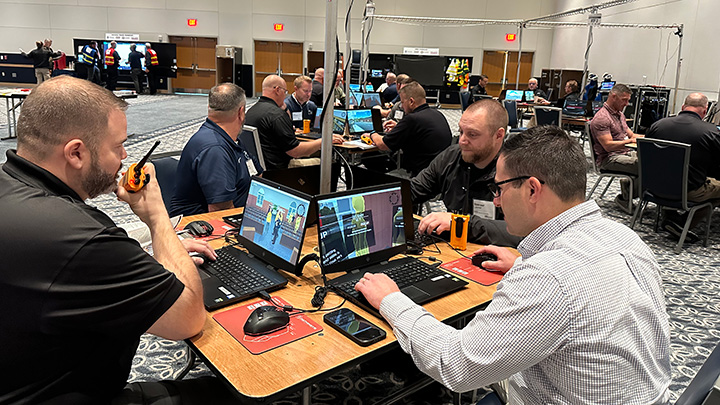
Walk into one of our ASIM Advanced classrooms and you'll see a room full of people on laptops. Looks like a video game. It isn't. What's happening in that room is decision-making, communication, and 60 responders from law enforcement, fire, EMS, and 911 learning to manage a violent event together, as one team. The laptops are just the window they're looking through.
That distinction matters, because it's the whole point. The software is the tool. The training is the thing.
We built NIMSPro because we needed it, not because we wanted to be a software company. Twenty years ago we were trying to teach incident management and we ran out of good ways to do it. Tabletops only go so far. Full-scale exercises cost a fortune and you get one shot at them. We needed a way to put a realistic incident in front of a team, let them run it, coach them through it, then do it again with something harder. So we wrote our own.
The stage play, and why everybody gets their own stage
Here's the way I explain it to people who ask.
Think of a stage play. The responders are the actors. Our instructors are the directors, setting the scene, calling the objectives, and coaching where and when it's needed. NIMSPro's job is to paint the scenery around everybody so the decisions feel real.
Now change one thing. It's not one stage. Because NIMSPro is first-person and the environments are huge, every single responder gets their own stage with their own scenery painted around them. A cop clearing a hallway sees that hallway. The medic in the casualty collection point sees the casualty collection point. Tactical, Triage, and Transport see the scene in front of them. They only see each other when they're actually in the same place, same as game day. That's what forces real communication. You can't manage what you can't see, so you'd better get on the radio and build the picture together.
It's not a perfect analogy. But it gets the idea across, and the idea is the part that counts.
What it is, under the hood
NIMSPro is a 3D simulation system. A responder stands in a first-person point of view and walks through a photo-realistic recreation of a real place, inside the buildings included, built to scale. Multiplayer, so the whole team is in the same incident at the same time, seeing one another, talking to one another, living with the consequences of the decisions they make.
We've narrowed what we use it for. It started as an all-hazards simulator and it can still do a lot of things. Today we point it at the two problems our responders most need to get right: active shooter incident management and mass casualty incident management. There are plans to expand that down the road. When that happens, it happens. For now, this is where it earns its keep.
Over a three-day ASIM Advanced class, our instructors run a team through about ten scenarios. Each one different. Each one a little harder than the last. We use our Coach-to-Success method right alongside the simulation, so every run turns into a lesson the team actually keeps. Nobody's trying to win the game. They're practicing the real work, stopping the threat, rescuing the wounded, securing the scene, until integrated response stops being a thing they read about and starts being a thing they do without thinking.
Real places, built to scale
Generic environments don't teach much. So we build real ones. Over the years we've stood up a deep library: a university campus, a high school campus, a commuter train station, an outdoor mall, a courthouse, a port and cruise ship terminal, an international airport.
The newest one is a complete hospital. And I mean complete. Full exterior, parking garages, interior including the lobby, the emergency department, operating rooms, the ICU, a med-surg floor. The artwork on it is some of the best work we've ever done. As far as we know, nobody else has a functioning 3D simulation of a hospital like this one. If your people have to plan for a violent event inside a healthcare facility, there is no other place to practice it like this.
One name, two ways to train
NIMSPro has grown into a family. Same foundation, two different ways to put it in front of responders.
The desktop system is the big one. It renders sprawling environments, a whole campus or an airport, at a scale and level of detail that lets an entire team operate inside one incident at once. That's what runs in our classrooms.
The other is NIMSPro VR, fully immersive headset training for focused, high-fidelity skill work. There's a reason we keep the big environments on laptops and the tight, optimized scenes in the headsets. Different tools for different problems. NIMSPro VR is great for drilling specific skills and decisions, quickly, and with very high fidelity. Different jobs, different tools, same family.
How agencies actually get it
For almost everybody, the answer is simple. You experience NIMSPro by training with us. We bring a portable lab of computers and servers to your site, turn a classroom into a full simulation training center, and our instructors run the class. You get every bit of the benefit without the pain of owning and maintaining the infrastructure.
We do, once in a while, license the desktop system to an agency that wants to build its own ongoing simulation capability. And here's where I'll be straight with you in a way most software companies won't.
This is serious infrastructure. Servers, dozens of laptops, a dedicated space, and people committed to running it and running it right. It's a real investment, and it only pays off for an organization that's actually going to use it correctly. I've talked more people out of buying NIMSPro than into it, and I'd do it again every time. I learned a long time ago that putting a powerful tool in the wrong hands doesn't help anybody. It doesn't help the agency that bought something it won't use, it doesn't help the responders depending on training that never happens, and it sure doesn't help our reputation. So if it's not a fit for you, I'll tell you it's not a fit. You'll get a straight answer either way.
Custom environments are the same conversation. If you need a specific campus or facility recreated in 3D, the right approach depends entirely on what you're trying to accomplish, so that one always starts with a phone call. And the first question is, "What problem are you trying to solve?"
The best way to understand what NIMSPro does is to see it do its job. Come look at how we use it in ASIM Advanced, and watch responders that walked in nervous walk out knowing how to run the play as a team.

