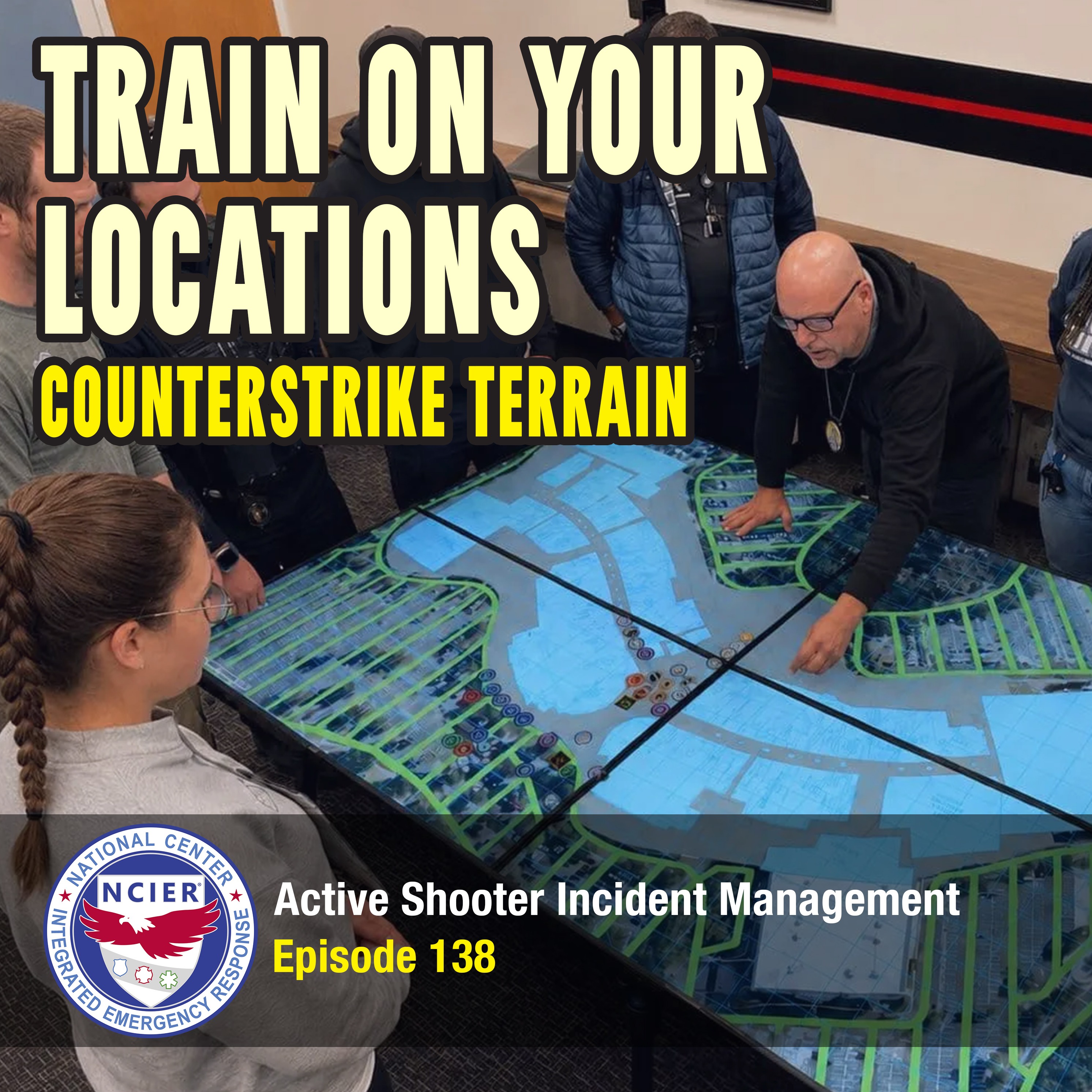
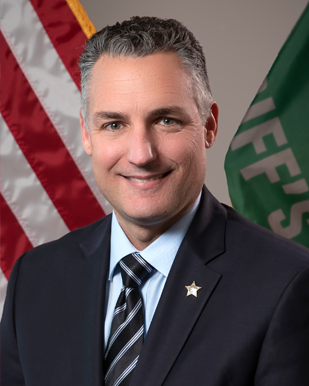
Oviedo, FL. Press Conference. In this video, Seminole County Sheriff Dennis Lemma shares why he believes NCIER’s Active Shooter Incident Management (ASIM) training is “second to none” for preparing public safety professionals. Over three days, more than 60 responders from roughly 25 organizations rotated through multiple ASIM scenarios in a high fidelity, technology driven environment. Sheriff Lemma explains how ASIM training accelerates experience, lets every participant work different command and operational roles, and produces some of the most honest, detailed debriefs he has seen in 33 years at the Seminole County Sheriff’s Office. He also underscores how bringing multiple agencies together in one controlled space builds true unified response while remaining more cost efficient than traditional field based exercises.
Transcript
Thank you for being out today, really covering this professional development for firefighters, police officers, deputy sheriffs, military personnel. What C3 Pathways is doing is second to none—embracing modern technology to prepare our peace officers and emergency responders for real-life scenarios that we face every single day. As you can see, this gathering has approximately 60 people in here from 25 different organizations that have, in many regards, never had the opportunity to work together before this.
Over a period of three days, they'll rotate through various positions—up to 11 different scenarios—but they'll spend time at each one of the positions learning and gaining appreciation and skill sets for areas outside their normal assignments. And when you look at today’s environment, particularly with public safety organizations, fewer and fewer people are staying 25 or 30 years.
So it is environments like this that allow us to expedite experience levels with trained professionals who bring decades of experience in scenarios like this to the table in a safe environment. Not only is it unique to pull 60 people together for a three-day experiment from all over the country to do this, it is also incredibly cost-efficient.
Normally it would take multiple locations, venues, and travel to be able to do this. Because of this unique environment in a controlled space, we can have real-life scenarios using technology in a virtual environment to make it as close to the real thing as possible. Just a couple of moments ago, we had what we call a hot wash debrief of a scenario, and the amount of candor and dialogue from everyone who spoke here—from their various assignments—as far as what worked and what did not work is more intensive and, quite frankly, more honest than what I’ve seen in 33 years here at the Seminole County Sheriff’s Office.
So C3 Pathways—there are a lot of great things going on here—helping our heroes, our public safety professionals, prepare to serve our community. And when you look at what’s going on in the country, it seems like every few weeks there’s some disaster somewhere that raises our eyebrows and makes us ask: what can we do better?
Well, this scenario, this environment, is exactly doing that. And I’m proud to have this hosted right here in Central Florida, and more specifically here in Seminole County. A lot of great things with Bill and his team, and we’re grateful for them to be a partner in what we do.
And Sheriff, we’ve seen you guys and other agencies do real-world training in school buildings or other facilities. How does this differ from doing those kinds of things?
Yeah, so when we do training—sometimes during the summer—we’ll take a school campus and do scenario-based training. One, it is a lot less expensive to do training like this in an environment like this. But interestingly enough, when you do exercises at a school campus or a large venue, everyone is out of each other’s sight, and you don’t have the opportunity to see how other areas actually play out—what works and what doesn’t work.
Getting everyone in the same room together, although separated enough by assignment, you can literally see things that don’t work out well. And I think it doesn’t matter what trade or profession you’re in—we’ve all been in scenarios where we come together in a large group, and whoever is facilitating the class says, “Okay, now we’re going to break into groups.”
Typically, if we’re being honest, 20% of the people do 80% of the work. Sometimes when those scenarios occur. This is the first time I’ve seen 60 people come together for an assignment where every single person here was actively engaged in what they were doing. And as I walked around the room—on the morning of the second day—they could explain in great detail what was going on.
I think that’s what makes this incredibly unique. Using a virtual environment to play out scenarios, to actually see good actors, bad actors, innocent witnesses, and threat concerns—it’s amazing. It took 33 years in my experience to get to the point where we are today.
And obviously, it’s people from a lot of different agencies across the state coming in here. What do you expect for your own people, and how does this help others in your agency?
Yeah, so the members of the Seminole County Sheriff’s Office that are here—I’m incredibly proud of their work. But I think I’m even prouder of the combined effort of public safety organizations coming together as if they all work for one organization.
Again, there are probably 25 different organizations—some large, some small, some medium-sized—but by the morning of the second day, they are a unified team. And I think the concept here is unified response.
Because when we respond to real-life scenarios, it is every single person within radio distance—and sometimes beyond—who shows up on these scenes. And absent deconfliction, reunification, and learning how to work well together, things can become more problematic than helpful.
So it’s environments like this that help us. And I think as citizens sit back and watch television, there’s a general expectation that we would be doing something just like this to make our schools safer, our hospitals safer, our courthouses safer, and our communities safer.
So again, great collaboration. As everyone here has looked around the room, you can see it. And those images really speak for themselves in terms of the benefit of what’s going on here.
So what are some of those real-life scenarios you’re looking at?
Yeah, so these real-life scenarios—there’s not one policing executive, emergency manager, or EMS professional who doesn’t watch these events closely. It doesn’t matter if it’s in Texas or outside Nashville—when we watch these stories play out across our country, we have a responsibility to go back to the drawing board and ask: what can we learn from these scenarios?
Of course, when you look at Parkland and what has happened here in the state of Florida, there are a lot of lessons to be learned. We have to take that, come together with trained professionals here at C3 Pathways, and use this independent review.
A lot of agencies are doing their own thing, but I think there’s a fundamental expectation. Sometimes we call what we do “training.” This extends well beyond training—this is professional development with an independent eye and honest dialogue between practitioners.
And it builds on the concept that there’s not one of us who is smarter than all of us. The collective IQ of any group is always greater than any one individual.
And that’s what’s going on here at C3 Pathways.