
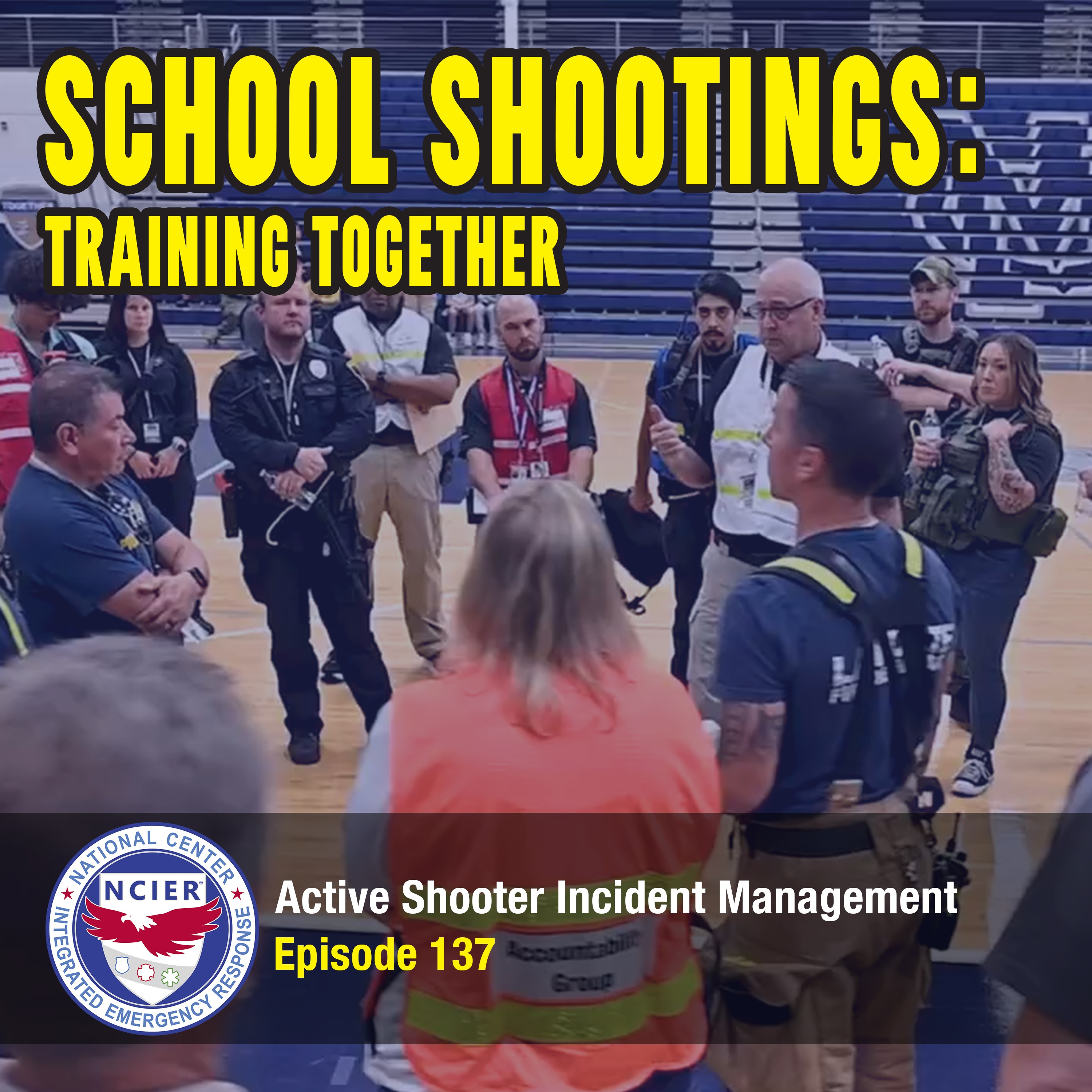
Ep 134: Active Shooter Training Buyer's Guide - Integrated Response
Episode 134
Published Jul 1, 2026
Duration: 22:36
Episode Summary
Most active shooter "integrated" training still happens in silos, with dispatch and emergency management left out entirely. In today's episode, the panel explains what true integration takes, from the first 911 call to one shared, signed playbook built on the ASIM Checklist.
Episode Notes
The biggest failures we see in active shooter incidents aren't at the doorway. They're between agencies that never really trained together.
This episode of the Active Shooter Incident Management Podcast is Part 3 of the Active Shooter Training Buyer's Guide. Bill Godfrey, Ron Otterbacher, Jill McElwee, and Billy Perry dig into what integrated response training should look like across dispatch, police, fire, EMS, hospitals, and emergency management.
They discuss:
- How integration really starts at the first 911 call
- Setting Realistic, Attainable, and Measurable (RAM) goals
- Getting everyone on a common playbook with the ASIM Checklist and one shared policy
- How emergency managers bridge the real "PPE": personalities, politics, and egos
If you're a chief, sheriff, fire or EMS leader, emergency manager, or training officer, this episode gives you a practical guide for building real integrated response capability, not just checking the exercise box.
View this episode on YouTube at: https://youtu.be/fkAkEo_NS_4
Transcript
Bill Godfrey:Across training for more than 30,000 responders, the biggest failures we see aren't at the doorway. They're between agencies. Integrated training has to have a few things. Ron, let's start with what's missing from the training that we have now for police, fire, and EMS that fails us?
Ron Otterbacher:
I think it starts from the beginning. It starts from the time the call is received. The call is received, it probably goes to law enforcement because of the active shooter event. But is fire department dispatch involved in it? Is there a conversation going on between them? Does that carry throughout the incident where, again, the integration is beyond just the tactical side of things, it's the response component, it's everything that has to happen. If the dispatchers understand what their responsibilities are and they can help understand what the other responsibilities from the tactical side or from the EMS/fire side, then they can help assure that we're meeting certain perspectives in that response.
Jill McElwee:
And we talk about trigger points a lot in our training.
Bill Godfrey:
Right.
Jill McElwee:
And there are things that happen based on that initial call. That initial call that may go to law enforcement, fire, EMS side of the house, we need to know that when we are looking at a potential mass casualty situation. Calls that need to be made possibly to hospitals. There are cascading effects that need to occur, and the only way we're going to know what needs to occur is if we're all working together, if we're integrated in our training, and for any incident, and specifically the active shooter.
Bill Godfrey:
You know, the interesting thing is, I think all too often people just forget.
Ron Otterbacher:
Right.
Bill Godfrey:
You're not going to do this by yourself.
Jill McElwee:
Right.
Bill Godfrey:
It is not just going to be your law enforcement agency. It is not just going to be your fire department.
Ron Otterbacher:
Right.
Bill Godfrey:
It's not going to be your EMS ambulances. It's going to be a whole bunch.
Ron Otterbacher:
Right.
Bill Godfrey:
Billy, how hard is it for law enforcement agencies with their different policies and procedures and rules and books and everything else to work with each other across jurisdictions?
Billy Perry:
You know, sometimes it's really easy. Sometimes it's really difficult. And I was about to say that I think a lot of the times the decision is not malicious, but it's a decision nonetheless. And I think they intellectually know that this is going to be a multi-agency issue and a multi-jurisdictional issue and a multi-discipline issue, but they forget about it or don't want to release their fiefdom at this juncture. And again, I think a lot of times it's not malicious. I think they're just so overwhelmed. They're treading water and they've forgotten that their goal was to drain the swamp.
Ron Otterbacher:
We live in a world of silos and the only way we can be successful is breaking down the silos. We've got to work together, but it all starts at training. We've got to integrate the training that we have. It involves the response, but you can't do any of that if you don't know what each other's expectations are.
Jill McElwee:
And Billy, earlier you had an analogy about the puzzle, and how we all are different pieces of the puzzle, of the bigger picture, if you will. And just know, training is where I'm going to find out what pieces you have.
Billy Perry:
Right.
Jill McElwee:
So I'll know my piece, when it's time to ut my piece in, when it's time, where my piece might need to go.
Billy Perry:
Right.
Jill McElwee:
So that's where that integration, I may not need to know the details of what you do, or I may not need to be an expert at what you do in law enforcement, but I do need to know what it is you're doing so that I can then play my part appropriately.
Billy Perry:
And I've seen those relationships carry from training to real life when I go, "I need Jill for Jill's piece of the puzzle. This would be amazing right here." And it actually does.
Jill McElwee:
Because you know my piece of the puzzle.
Billy Perry:
Because I know your piece of the puzzle.
Jill McElwee:
Exactly.
Bill Godfrey:
Okay. So the biggest gap we have right now in training is that the integration is just nonexistent. We're training in silos with your discipline and your agency. We're not inviting the other agencies to train with us, other disciplines to train with us, things like that. So let's go around and talk about what is on your list of requirements for integrated training. How do you modify the training that is getting done today to make sure that integrated is front and center in getting the work done?
Billy Perry:
Have a goal. This is what we're going to accomplish. This is what I want to see. And you meet with the leaders of each discipline, meet and say, "What do you want? I want us to accomplish this today. I want us to accomplish this today," and have a goal-focused and measurable outcomes. Like, for all of our goals, I have a requirement of RAM. It has to be realistic, attainable, and measurable. And I want it to be realistic and attainable and measurable, and this is what we're going to do, and this is what we're going to see. Because I've had interdisciplinary training that was amazing, and all that was done. And I've had interdisciplinary training that was horrific and a monumental waste of time, and none of that was done.
Jill McElwee:
Mm-hmm. Yeah.
Billy Perry:
I feel like you've lived that as well.
Jill McElwee:
Oh, absolutely. In the training world, I have found success in letting people know what it is that is expected of them or what their part is. And I say them and they, and that we as first responders, we all are problem solvers. I want to know what it is that I bring to the table that's going to help solve this problem.
Billy Perry:
There you go.
Jill McElwee:
So if early on integrating that training by letting you know, "This is what I'm expecting of your agency. So in law enforcement, I'm going to need you to protect my RTF. So we're going to train together if that's the training we're doing. And I'm going to bring the dispatchers in because I want the dispatchers to know that this is how the communication needs to flow on both that law enforcement and that fire EMS side." If it's bringing in your emergency management officials that we haven't even-- They're part of a key component of our first response to a major incident such as an active shooter incident.
Billy Perry:
Right
Jill McElwee:
Because they have the resources. Just knowing what you have and knowing what you bring to the table. Those are the two super important things I agree, and I think you bring up a point.
Billy Perry:
It's a start of a relationship.
Jill McElwee:
Yeah.
Billy Perry:
And no relationship survives if you don't spend time together. None of them. And I think this is the beginning of a relationship, and I think it starts out slowly with this is what we can do. This is what we can do. This is what I can do for you. This is what I'll do for you. And it moves, and it morphs, and it grows, and it's not just a one-time ad hoc, "Hey, I'm Billy." "Hey, I'm Jill."
Jill McElwee:
Mm-hmm. Yeah.
Billy Perry:
And I think it's the start of a relationship, and you have to build that relationship, foster that relationship, and let it grow.
Bill Godfrey:
Ron, what's on your list? Integrated training, things you want to see.
Ron Otterbacher:
It starts at the door. You got to check your egos at the door.
Billy Perry:
Amen.
Ron Otterbacher:
We can't be successful without fire EMS, but we can't be successful without other law enforcement components. I don't care about the rivalries we may have. Rivalries are fine as long as they're done in fun, but when they affect the actual ability to carry on the mission, then we've got to get past it. The other thing is we have exercises on a fairly regular basis. Exercise is supposed to test our capabilities, but we forget the training component that's supposed to lead to the exercise, and that training needs to be from all different levels. The key is the integration. We've got to understand what each other does, what each other's expectations are, and what each other's needs are, so that we can work together, have that symphony, where we're all playing on the same sheet of music.
Billy Perry:
Right.
Bill Godfrey:
Ron, I couldn't agree with you more on the rivalry subject. I doubt that there's anybody in our audience that's listening to this that doesn't either know of their own agency or an agency in their jurisdiction where a rivalry has gotten in the way of making the right decisions and doing the right things. For me, it starts at the very basics. If you're not doing integrated training now, it starts with getting the chiefs and the training officers to understand your training needs to be opened up to the other agencies in your area, period. Pick up the phone, call them, and say, "Hey, Friday, we're going to be doing training, this subject, this location. We'd like you to send over one crew. Send over two officers. Send over one engine company. Give us one ambulance for just an hour or two, whatever you can spare. But come participate with us It's going to be great training." And it starts that simple.
All the years on the job, I've watched headquarters, the puzzle palace, try to legislate change downstream, and rarely have I seen that be successful. But on the flip side, I have seen training lead change successfully a very large percentage of the time.
Billy Perry:
That is a great point.
Bill Godfrey:
Right?
Billy Perry:
100%.
Ron Otterbacher:
It comes from relationships. It's easy for me to tell you no if I don't know you.
Jill McElwee:
Right.
Ron Otterbacher:
I've got nothing involved with you.
Jill McElwee:
Good point.
Ron Otterbacher:
But if I have a friend, someone that I feel I need to work with, then I'm not going to tell them no. I'm going to do everything I can to make them successful. Relationships run the world.
Billy Perry:
They do. And a lot of time, the boots on the ground are friends.
Ron Otterbacher:
Right.
Billy Perry:
And it's the upwards that don't get along.
Ron Otterbacher:
Right.
Billy Perry:
You know?
Ron Otterbacher:
So true.
Billy Perry:
Mm-hmm.
Bill Godfrey:
And you may have a great ground operation, but if your leadership and incident management team don't come to training, don't participate, don't have relationships with the other agencies, how long before a decision-
Billy Perry:
They set up for failure
Bill Godfrey:
... Yeah.
Billy Perry:
100%.
Bill Godfrey:
They make a screwed-up command decision and the whole thing goes sideways.
Billy Perry:
100%.
Bill Godfrey:
So integrated training, all areas. So let's talk on the tactical side. What does integrated training look on the tactical side? Who needs to be invited? Dispatch?
Billy Perry:
Dispatch.
Bill Godfrey:
Law enforcement, obviously.
Billy Perry:
Obviously.
Ron Otterbacher:
From the patrol officer or deputy to the SWAT operator to everyone that's involved, the incident commander.
Bill Godfrey:
Including first line supervisors.
Ron Otterbacher:
Yes, absolutely.
Billy Perry:
Including first line supervisors.
Bill Godfrey:
Okay.
Ron Otterbacher:
They're going to be there for anyone else will.
Bill Godfrey:
Fire EMS?
Billy Perry:
Yes.
Bill Godfrey:
Needs to be present. Now, just your jurisdiction?
Billy Perry:
No. I think all the outlying jurisdictions, I think anybody that touches, whether they're part of the JTTF or whatever they're going to be, I think everybody that isconstrained by geography should be there.
Jill McElwee:
Absolutely. I think knowing your demographics of your community, let's back it away from us. Let's look at those that we are committed to serve and protect. So if we're looking at an area where our high schools are 4 or 500 plus, and so when you look at we have maybe mass gathering areas in our community. Knowing your demographic, and then you start peeling back those layers as to what would a response look like to a large incident. You will run out of lines on your paper when you start looking at the agencies, the disciplines, the components within your community that you are going to rely on.
Billy Perry:
Agreed.
Jill McElwee:
If you're going to rely on them during those gray sky days, as we talk in the hurricane world or the natural disaster world let's look at those manmade disasters. Well, who will we need? Let's get them on those blue sky days together, talking so that, to your point, Ron, great point, that now we know each other. A lot harder for me to turn you down when I know you to come to training.
Billy Perry:
And how often do we include even school resource officers, as crazy as it sounds?
Jill McElwee:
Right.
Billy Perry:
How often do we include them? How often do we include school nurses?
Jill McElwee:
Absolutely.
Billy Perry:
Because honestly, we did that. Plug in the nurses. Have your own RTF right there on the scene, and we don't do that.
Bill Godfrey:
And I think emergency management is another key. They don't necessarily need to be at every training session, but they certainly need to be plugged in and included because they're the ones that have the relationships. If Ron and I don't know each other, don't have a relationship, I'll bet I know an emergency manager that can get Ron and I an introduction and say, "Hey, let's try to get this done." I think the other missing ingredient is all too often when you're the agency trying to do this and trying to do the reach-out, you forget about making it convenient for your other neighbors. So you like the convenience of being able to run this training at your training center, and that's nice, but it's convenient for you, it's geographically convenient for you, and the facilities are convenient.
Billy Perry:
Right.
Bill Godfrey:
But how often do you actually need a full training center for conducting this kind of training?
Billy Perry:
Right.
Bill Godfrey:
Not that often.
Billy Perry:
You don't.
Bill Godfrey:
Not that often. You can get a small part of a school. You can use a firehouse for a lot of this stuff.
Billy Perry:
Yeah.
Bill Godfrey:
So offer to host the training in different locations to make it easier for other people to be able to get to and participate.
Jill McElwee:
Yeah. That's the challenge is for every training officer, for every member of an agency that understands the importance, the dire importance of integrated training, is just find a way. We're from the South, now is it that we're going to have a lot of sweet tea here. Really sweet tea.
Bill Godfrey:
Right.
Jill McElwee:
So you guys show up, we got sweet tea and cookies at the firehouse. So come to this training. Whatever it takes to get people, that's what's required.
Bill Godfrey:
I agree.
Ron Otterbacher:
It all goes back to relationships. I've seen training components from different agencies work together despite the fact that maybe the command staffs don't get along as well as they should, but these people make it happen because they have relationships.
Bill Godfrey:
Which brings me to a piece of this that we haven't talked about yet, and that's getting everybody on a common language, common playbook, policies, procedures. Look, there is no question that two neighboring police departments are going to have different policies. The two neighboring fire departments are going to have different SOPs. It's going to happen. But true integration is going to require you to get everybody on the same page. And if you pick a tool, use a tool like the Active Shooter Incident Management Checklist that we provide, it provides a playbook that >doesn't get anybody cross or violating their policies and procedures. And if you do have policies and procedures that go against what's in the ASIM checklist the national standard, endorsed by the National Tactical Officers Association.
Billy Perry:
Right.
Bill Godfrey:
Respectfully, the Hut Hut boys.
Billy Perry:
Right. 100%.
Bill Godfrey:
Yeah, absolutely. Yeah, you might want to take a look-
Billy Perry:
You might want to take a look at that.
Jill McElwee:
Absolutely
Bill Godfrey:
... and figure out why.
What else needs to be on that integration, on the policy procedure, getting everybody on the same playbook list?
Ron Otterbacher:
Like you said, the policies, or at least understanding the policies, understanding the differences in policies. If I've got a policy, the example I used back when I used to run the K9 unit, we had a different stance than some of the city departments did as far as deployment of K9s. There were times where we would deploy, and they couldn't deploy. So just having that understanding that we don't waste time in trying to figure out what it is during the incident. We already know. So if this situation happened, I'm deploying rapidly, and we'll figure out from there.
Bill Godfrey:
Yeah. Here's a question for the two of you guys. If the incident is in your jurisdiction, so you have command and authority over the jurisdiction, does your playbook rule?
Ron Otterbacher:
Yes.
Bill Godfrey:
If I'm coming into your jurisdiction, I got my own policies and procedures.
Ron Otterbacher:
For your people.
Jill McElwee:
I would hesitate on for the medical side because it's specific for your medical.
Bill Godfrey:
Right.
Jill McElwee:
For a paramedic, you would fall under your medical director.
Ron Otterbacher:
You're under the license of your others. Yeah.
Jill McElwee:
But the only way we're going to know that is when we train together. It may be your policy on the law enforcement side that we're going to put three in every ambulance. It may be in my medical direction that is not allowed, that we can only have a certain number. That's a specific, but a specific that is identified during an integrated training.
Billy Perry:
And I think it is something that has come up, but none of it is outside statutes. No matter whose policy it is, it's still within statutes. And I think you're operating in our jurisdiction, and even where I'm from, and I was very blessed to come up professionally where I came up, you could shatter a policy as long as you didn't break one of the four core values. And if you said, "I totally did it, and I know that it says don't ever do it, and I did it, and it was amazing."
Jill McElwee:
And it worked.
Billy Perry:
"It worked flawlessly, but I was still showing respect for each other, I was worthy of trust, I was community focused, and I was always improving. I didn't break any of those four, and I was okay." And I think if the leadership hashes that out before.
Jill McElwee:
Yeah.
Billy Perry:
Because it's for the greater good. And you've got to break eggs to make an omelet sometimes.
Ron Otterbacher:
The other thing is training allows you to sit back and reflect on differences in policies. And you may say, having written many policies, that, "I can modify mine a little bit so we're in line with everyone." And again, getting rid of that ego at the door.
Billy Perry:
Right.
Ron Otterbacher:
And saying, "No, this just makes sense. Let's all do it the same way."
Billy Perry:
Right. "I didn't mean to mess this policy. This could be better if we did it this way."
Ron Otterbacher:
Right.
Bill Godfrey:
Which I think goes to the final linchpin here. In addition to the ASIM checklist, we also have a sample policy for people to be a look at, and it's written in the military style of commander's intent, where the policy dictatesThis is what the outcome that the commander wants Generally, we're going to follow these procedures in order to get there, and it incorporates the ASIM checklist process as part of that, because it is the national standard there. But it also empowers the responders to do something different if they determine that they need to.
Jill McElwee:
Yes.
Ron Otterbacher:
Right.
Bill Godfrey:
It gives them the authority, right in the policy, and almost more importantly, I don't know if it's more important or not, but it's way up there. It's one policy that everybody signs. So it's not the police department has this policy, I'm going to then take that language and put it in my own format and put it in my own book. Nope. Soon as you do that, you got drift. You absolutely have drift. It's the same piece of paper that is signed by the chiefs, by the emergency manager, by everybody. And in fact, emergency managers are a good one to be able to get this done, because who deals with countywide policies that involve multiple disciplines and multiple agencies?
Ron Otterbacher:
Emergency management.
Jill McElwee:
That's it. Your emergency management. And emergency management, they're the folks that can help you a lot with your PPE. And when we say PPE, we're not talking about the personal protective equipment, we're talking about the PPE involved when you bring in those multi-agencies, multi-jurisdictions, as Ron has alluded to it, personalities, politics, and egos. They all are a factor, and we are naive if we think they are not. It is absolutely a factor, but your local emergency management office could be a great conduit to battle that.
Ron Otterbacher:
I was blessed during my career. I chaired the Tactical Event Review Committee, and what we'd do is we would look at any serious event that we had. We would determine whether the officer or deputy's response was appropriate, whether training was appropriate, whether our policies were appropriate. And although I felt we had a pretty sound group of policies, there were times when we said, "No, our policy failed everything and we changed the policy." We just need to look at that at a broader perspective to bring the integration together.
Bill Godfrey:
If you're a leader, do not let personalities, politics, and egos get in the way of doing what you know is the right thing to do, and that is serving the community that you've been entrusted to serve. If you're an emergency manager, you already know it more than best that personalities, politics, and egos always get in the way, which is partly why emergency managers are kind of like the political liaisons. They're a little bit outside of the chain of command, and they're the, "Oh, come on, do this as a favor."
Ron Otterbacher:
They're the bridge the gap people.
Bill Godfrey:
They're the bridge the gap people. And I'll leave you with this. If you're a training officer, and you're watching personalities, politics, and egos get in the way, pick up the phone, call the training officer at your neighboring jurisdiction and say, "Hey, I'd like to try to start this." And don't be put off if the answer is no the first time. Don't be put off if they say yes the second time, but nobody shows up.
Ron Otterbacher:
Right.
Jill McElwee:
That's right.
Bill Godfrey:
Stay at it.
Jill McElwee:
Yeah.
Bill Godfrey:
Because the reward is you helped save lives. You helped do the right things for the right reasons.
Ron Otterbacher:
End of the day, it's community service.
Bill Godfrey:
It is.
Ron Otterbacher:
100%.
Bill Godfrey:
It's about saving every life that can be saved.
Ron Otterbacher:
Right.
Bill Godfrey:
Thank you for coming in and talking about this, and we've got one more in our series that we've been doing on how to select great training for your active shooter training and preparedness.
If you haven't already, click the like and subscribe button to make sure that you get notification about the final episode in this series. Thank you to our producer, Karla Torres, and until next time, stay safe.